PCF-Study 2026: Product Carbon Footprints in the DACH Region
Cross-industry benchmarks for your PCF strategies – based on insights from around 280 companies across the DACH region.
This study provides a data-driven perspective on how manufacturing companies are currently implementing Product Carbon Footprints, what drives these efforts, and where the biggest challenges in scaling lie. It highlights what is already working – and where companies are still at an early stage.
PCF is gaining relevance – but is not yet being implemented at scale
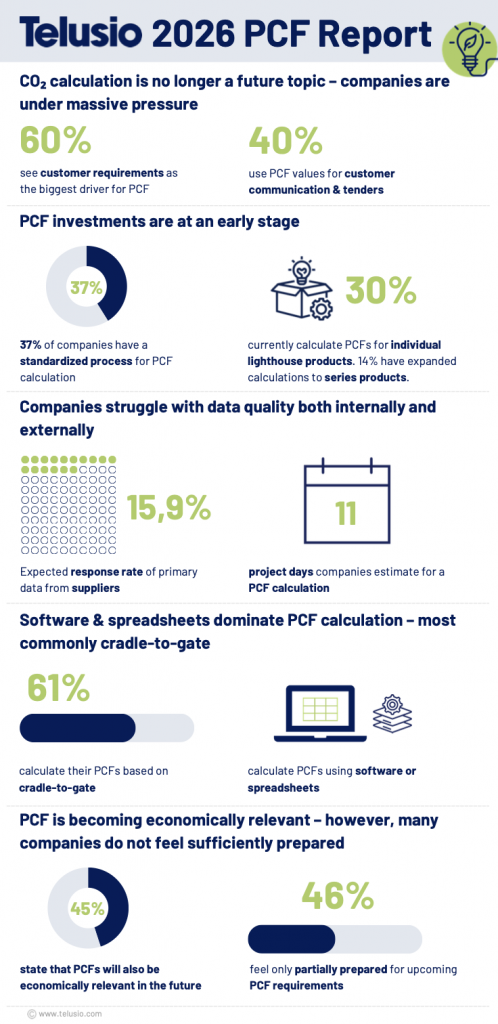
55% of companies engage with PCF on a regular basis, yet 40% still do not have an established calculation. In many cases, PCF remains in the pilot phase.
Customer requirements are driving progress more strongly than regulation
For 60% of companies, customer requirements are the primary trigger for PCF initiatives – regulatory factors currently play a secondary role.
Scaling remains the biggest challenge
PCF calculations are often carried out only selectively: 30% calculate PCFs for individual products, but only 14% have extended this to series products. Companies estimate the effort required for a single PCF calculation at around 11 days.
Data availability is the key bottleneck
Missing supplier data and insufficient master data quality are among the biggest challenges. The response rate for supplier data is only around 16%.
PCF is becoming economically relevant – but many companies are not yet prepared
45% see PCF as becoming economically decisive in the future, while 46% feel only partially prepared for it.
Download the PCF Study 2026 now – including a one-pager for a quick overview!
In addition to the detailed study slides, a compact one-pager is available – ideal for sharing internally with teams and management.