
Blog
Insights from PCF practice
Studies, analyses and experience from projects with industrial companies.Articles are currently available in German only.
October 3, 2024 · 3 min read · Dr. Johannes Weibl
CSRD: Calculating the Emissions of Purchased Goods in Scope 3

Articles are currently available in German only.
With the introduction of the Corporate Sustainability Reporting Directive (CSRD), many companies are obliged to record and report not only their direct emissions (Scope 1 and 2) but also Scope 3 emissions according to the GHG Protocol (Greenhouse Gas Protocol).
Why are Scope 3 emissions important?
This rule is crucial, as Scope 3 emissions often account for the largest part (up to 70–80%) of a company’s CO₂e footprint. They cover all indirect emissions arising along the value chain. The focus is particularly on the emissions of purchased goods and services (Scope 3.1), which usually make up the largest share. These emissions arise from the manufacture and transport of products that companies buy from various suppliers for further processing.
Where does the data for Scope 3 emission calculation come from?
However, calculating a company’s Scope 3 emissions completely can be a challenge.
In principle, it is up to the suppliers of a company subject to CSRD reporting to be able to provide primary values on the CO₂e emissions of a product on request.
However, this often does not reflect reality. Only a small fraction of suppliers can provide emission values, which makes primary values hard to obtain for the reporting company. In addition, querying suppliers can mean extra administrative work for a company, as numerous suppliers have to be contacted.
While the long-term goal should be to obtain and manage primary data from suppliers, Scope 3 emissions already have to be calculated today. This is where the activity-based calculation methodology comes in. Using scientific approaches and regulations, emission values can be derived from complete master data.
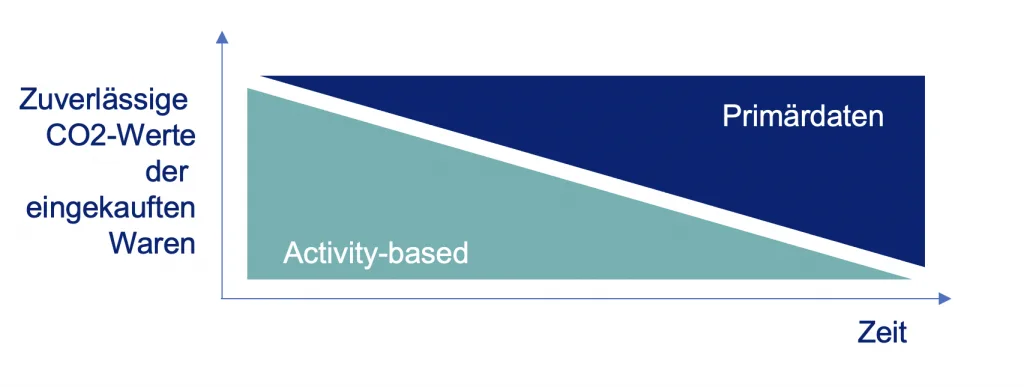
Data gaps in master data as a challenge in Scope 3 emission calculation
But what if the master data is not complete either? Another challenge in calculating Scope 3 emissions is the complete documentation of a company’s master data. Articles often exist in internal systems without material or weight information, and supplier information can also be hard to access in the ERP system. This makes a correct and complete calculation of emissions difficult.
TELUSIO Intelligence
paves the way for complete and robust Scope 3 emission calculation.
TELUSIO Intelligence uses AI to fill in missing data by drawing on the context of a purchased product. This allows companies to calculate their emissions efficiently without time-consuming manual data research.
TELUSIO Intelligence thus enables companies to calculate CO₂e emissions for purchased goods in a CSRD-compliant, activity-based way despite incomplete master data and missing primary values. This procedure is verified according to ISO 14067 and the GHG Protocol. These calculations extend not only to simple manufactured parts but also to more complex products consisting of several components.
Step-by-step emission calculation:
1. Activity-based calculations:
TELUSIO Intelligence can efficiently analyse a large number of products and calculate activity-based CO₂e emissions – for simple and complex goods alike.
2. Primary data from suppliers:
In addition to the initial calculation, TELUSIO also helps companies collect primary data from suppliers and incorporate it into the emission calculations. This improves data accuracy and reduces uncertainty. Targeted supplier engagement can build closer collaboration to ensure the availability of high-quality data.
How does prepared data make calculating the Product Carbon Footprint (PCF) easier?
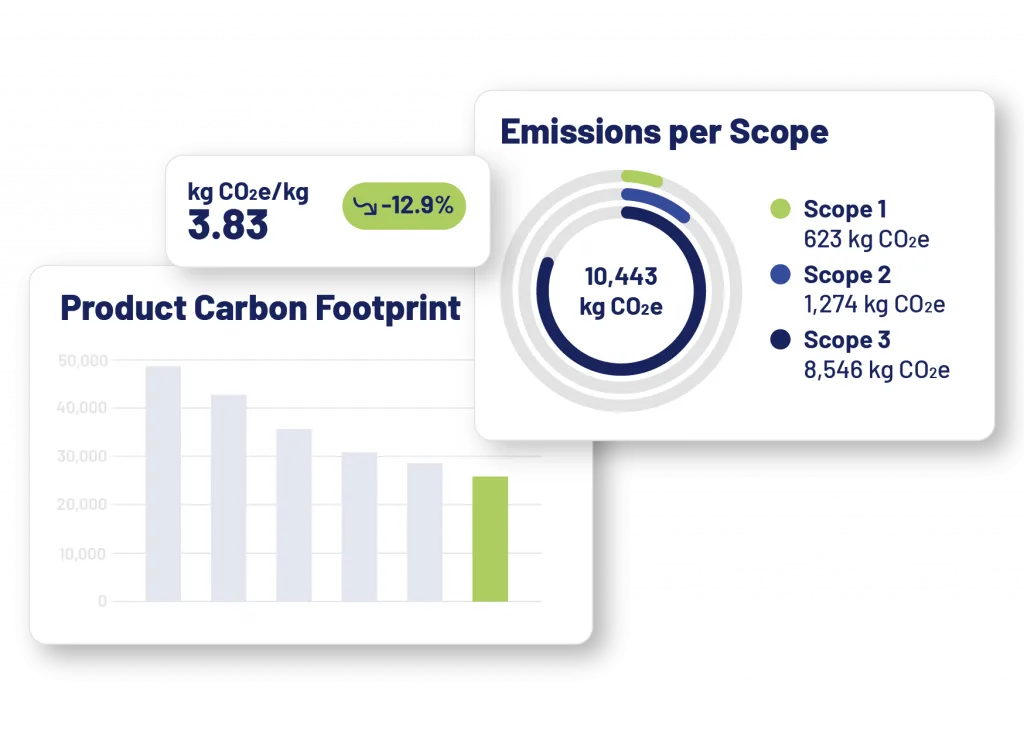
With the TELUSIO software, companies can considerably simplify calculating the Product Carbon Footprint (PCF).
Already prepared data, such as material and weight information for purchased goods, flows directly into the calculation process. This significantly speeds up and refines the determination of CO₂e emissions based on current regulations.
Telusio’s view
The CSRD brings extensive obligations for calculating and documenting Scope 3 emissions. With automated data preparation, companies have the opportunity to carry out precise CO₂e calculations.
With effective supplier management, algorithm-based data preparation and activity-based emission calculation, TELUSIO helps overcome the challenges of recording Scope 3 emissions while meeting the requirements of the CSRD.
Are you ready to record and sustainably manage the carbon footprint of your purchased goods and services? Talk to us to find out how we can support your company!


Your customer is asking for a PCF?Let’s talk.
Discover the easiest way to audit-ready PCFs – AI-powered and expert-reviewed.
Book an initial call