
Blog
Insights from PCF practice
Studies, analyses and experience from projects with industrial companies.Articles are currently available in German only.

Articles are currently available in German only.
Practically all of a company’s actions can be viewed from a carbon perspective – meaning that all activities, products and purchases are associated with a certain amount of greenhouse gas emissions. Companies face the challenge of knowing which emissions absolutely must be measured and how to quantify the emissions of all their activities. This is where the Greenhouse Gas Protocol comes in.
What is the GHG Protocol and why is it relevant?
The Greenhouse Gas Protocol (hereinafter: GHG Protocol) is an internationally recognised guideline for recording and reporting greenhouse gas emissions. It was developed jointly by the World Resources Institute (WRI) and the World Business Council for Sustainable Development (WBCSD). The aim of the GHG Protocol is to help companies worldwide take into account the potentially drastic changes in our future associated with greenhouse gas emissions.
The GHG Protocol divides greenhouse gas emissions into three categories: Scope 1, Scope 2 and Scope 3. This division is based on the degree of control a company or organisation has over the respective emission source, and not necessarily on the type of emissions themselves. Over time, the GHG Protocol has established itself as the world’s most recognised and most widely used standard for measuring all three emission scopes. It is used by governments, companies and organisations worldwide as the standard instrument for carbon accounting.
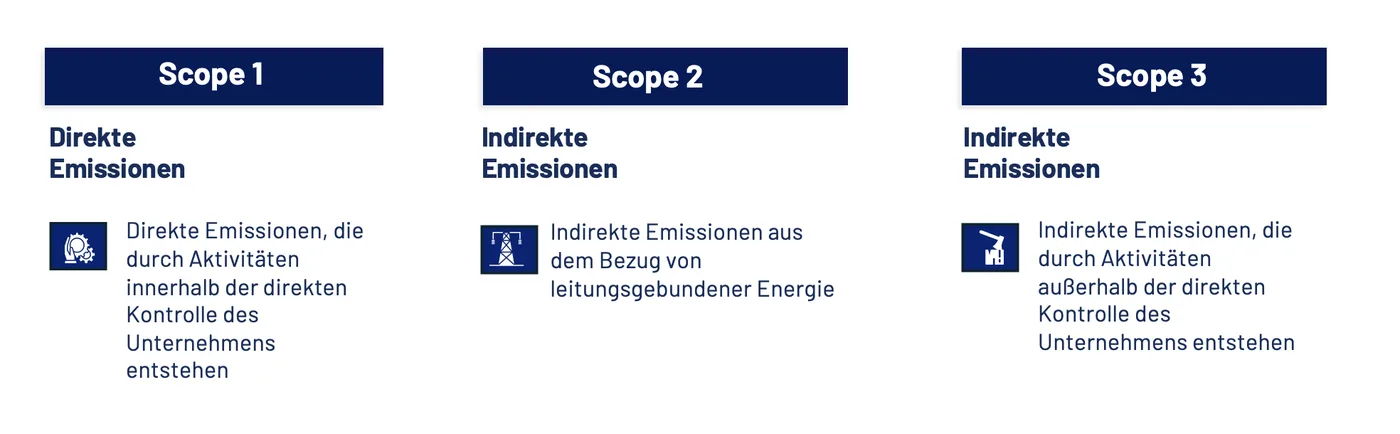
Overview of the different scopes of the GHG Protocol
Scope 1 – direct emissions
Scope 1 covers direct greenhouse gas emissions arising from the combustion of fuels in the company’s own facilities and processes. These emissions are under the direct control of the company or organisation. Reporting Scope 1 emissions is mandatory.
The four Scope 1 emission categories are:
- Stationary combustion (e.g. emissions from fuels or heat sources caused in stationary facilities)
- Mobile combustion (e.g. emissions from burning fuels, caused by vehicles)
- Process emissions (e.g. chemical fumes released during production)
- Fugitive emissions (e.g. leaks of greenhouse gases such as refrigerants)
Scope 2 – indirect emissions
Scope 2 of the GHG Protocol considers indirect greenhouse gas emissions arising from the following activities:
– purchase and use of electricity
– purchase and use of steam
– purchase and use of heat
Scope 2 emissions arise outside the company’s direct control, but can be influenced indirectly by the chosen electricity source. The two common methods for Scope 2 accounting under the GHG Protocol are the market-based and the location-based method:
- Market-based method: the calculation is based on the average emission factor of the energy mix that a company purchases from its energy suppliers
- Location-based method: the calculation is based on the average emission factor of the company’s location. Country-level values are often used here
Companies must report both values but should choose one method as the basis for their targets. Reporting Scope 2 emissions is mandatory.
Scope 3 – indirect emissions
Under the GHG Protocol, Scope 3 covers other indirect greenhouse gas emissions arising from activities outside the company’s direct control. These include emissions along the entire value chain, such as transport, procurement, waste disposal and use of sold products. Measuring and controlling Scope 3 emissions can be complex, as they often arise over the entire life cycle of the product.
These “value chain emissions” are the most common and most influential source of greenhouse gases for companies. They arise from the company’s activities, but the company has no direct control over the resulting emissions. More detailed information on the calculation can be found here.
Reporting Scope 3 emissions is optional under the GHG Protocol.
Categories of Scope 3 emissions
The GHG Protocol divides Scope 3 emissions into upstream and downstream emissions. Scope 3 emissions can also be divided into 15 categories, although not all of them are equally relevant for every company. Further explanations and examples are provided here by the Bavarian State Government.
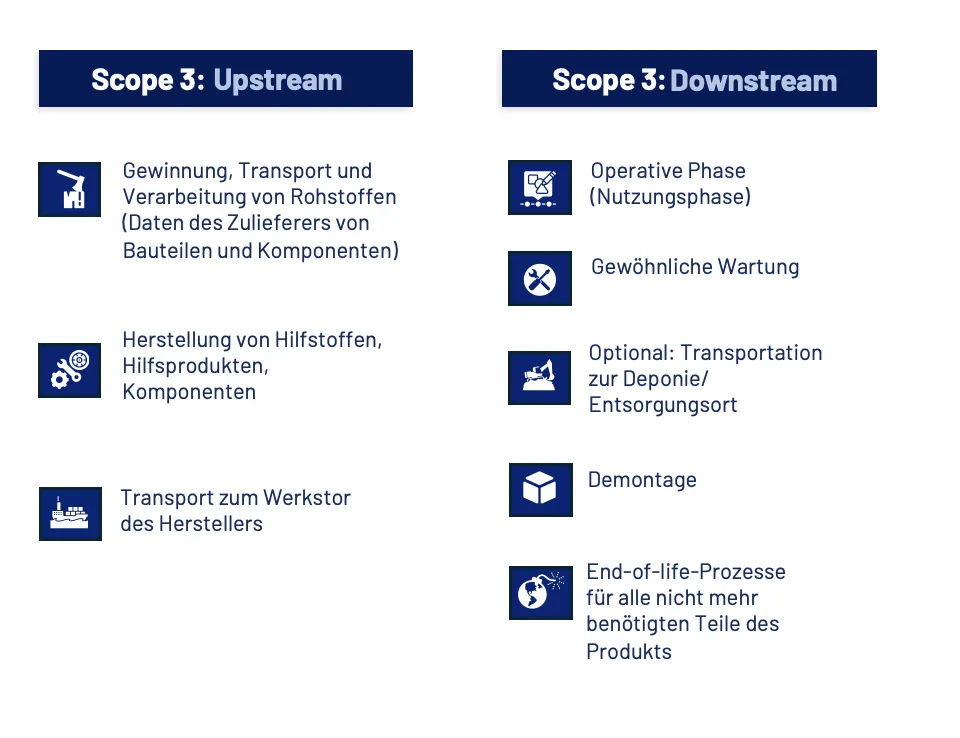
Upstream emissions according to the GHG Protocol
Upstream emissions refer to indirect greenhouse gas emissions within a company’s value chain that arise from the purchase of goods and services. They are generated by suppliers and other external sources before products or services are delivered to the company.
These emissions have a cradle-to-gate emission impact, meaning that they cause emissions from the point of production until arrival at a store or point of sale. Companies must take into account the extraction, production and transport of purchased goods or services.
The eight upstream emission categories are:
- Purchased goods and services
- Capital goods
- Fuel- and energy-related activities
- Upstream transportation and distribution
- Waste generated in operations
- Business travel
- Employee commuting
- Upstream leased assets
Downstream emissions according to the GHG Protocol
Downstream emissions are indirect greenhouse gas emissions associated with a company’s sold goods and services. They arise from the use of the company’s products or services by end consumers or other organisations.
These emissions occur after the product has left the company’s control, which is why assessing and reporting downstream activities in Scope 3 can be challenging.
The seven downstream emission categories are:
- Downstream transportation and distribution
- Processing of sold products
- Use of sold products
- End-of-life treatment of sold products
- Downstream leased assets
- Franchises
- Investments
Telusio’s view
While Scope 1 and Scope 2 emissions must be reported, accounting for Scope 3 emissions is noted as optional in the GHG Protocol. However, Scope 3 emissions account for a large share of a company’s total greenhouse gas emissions and should therefore not be neglected.
It is also important to distinguish between the requirements of the GHG Protocol and those of the CSRD and the Science Based Targets. To ensure more precise reporting, companies are obliged to account for these emissions under the CSRD. Setting a Science Based Target is also only possible with accurate accounting of Scope 3 emissions.
Accurate documentation of all emissions is therefore strongly recommended, not only to comply with legal requirements but also to be able to develop an effective sustainability strategy as a company.
The Product Carbon Footprint of your product is highly relevant for your buyer/customer for their Scope 3 reporting. The Product Carbon Footprint results feed into their reporting for 3.1 purchased goods and services or 3.2 capital goods, as well as 3.4 upstream transportation.



Your customer is asking for a PCF?Let’s talk.
Discover the easiest way to audit-ready PCFs – AI-powered and expert-reviewed.
Book an initial call