
Blog
Insights from PCF practice
Studies, analyses and experience from projects with industrial companies.Articles are currently available in German only.
June 27, 2024 · 5 min read · Dr. Johannes Weibl
Corporate Sustainability Reporting Directive (CSRD)

Articles are currently available in German only.
The European Corporate Sustainability Reporting Directive (CSRD) came into force on 5 January 2023. This new European Union directive obliges affected companies to publish detailed reports on their sustainability performance.
The CSRD is part of the European Green Deal, which aims to make the EU climate-neutral by 2050 and meet the United Nations’ Sustainable Development Goals (SDGs).
Since 2024, the CSRD has updated and strengthened the existing Non-Financial Reporting Directive (NFRD). It will enlarge the group of companies required to report and in some cases also lead to an extension and standardisation of the reporting content. This content is shaped by the European Sustainability Reporting Standards (ESRS) and by an adapted understanding of materiality for the disclosures in the sustainability report.
What is the Corporate Sustainability Reporting Directive (CSRD) and what is its aim?
The CSRD is an EU directive that aims to improve the transparency and quality of sustainability reporting. Companies must now disclose more comprehensive and detailed information on environmental, social and governance (ESG) topics.
The directive aims to provide publicly accessible and comparable information on companies’ sustainability-related risks and opportunities.
This is intended to help direct financial flows into sustainable economic activities (sustainable finance) and thus promote the transition to a sustainable and competitive economy in line with the Green Deal.
How is the CSRD transposed into national law?
As the CSRD is a directive, it does not apply directly but must be transposed into national law. At the end of March 2024, the German Federal Ministry of Justice presented a draft for transposing the CSRD into German law.
The necessary adjustments are mainly made in the accounting provisions of the German Commercial Code (HGB), but also through amendments to the Supply Chain Due Diligence Act.
For 2024, the EU announced sustainability reporting standards for small and medium-sized enterprises (SMEs): a mandatory standard for listed SMEs (LSME) and a voluntary standard for sustainability reporting for non-listed SMEs (VSME). According to the European Commission’s work programme, the sector-specific standards, also initially planned for 2024, will probably not be published until 2026.
Who is affected by the CSRD?
The CSRD applies from the 2024 financial year to all large companies already covered by the NFRD. For other companies listed on an EU-regulated market and for non-listed companies, the CSRD applies from the 2025 financial year if they meet two of the following three criteria:
- Balance sheet total of more than €25 million
- Revenue of more than €50 million
- More than 250 employees
This covers around 50,000 companies in Germany, compared with the approximately 11,700 companies currently covered by the NFRD. Micro-enterprises are excluded from the scope.
Would you like to know from which financial year your company is affected by the CSRD? You can find more information in our article on the CSRD timeline.
What must be reported under the CSRD?
The law does not prescribe a fixed reporting format. Instead, national or European sustainability reporting standards can be used. In Germany, the reporting standards of the Global Reporting Initiative (GRI) and the German Sustainability Code (DNK) are mainly used.
The CSRD anchors the principle of “double materiality”. Under the CSRD, double materiality is considered given if at least one of the following two perspectives applies:
1. Inside-out perspective (“impact materiality”)
Environmental and social materiality, also known as impact materiality, reflects an inside-out perspective. Here, companies must take into account the external effects of their business activities, in particular the impact on society and the environment. This includes, for example, their contribution to air and water pollution and their greenhouse gas emissions, which intensify global climate risks.
2. Outside-in perspective (“financial materiality”)
Financial materiality means taking an outside-in perspective. Companies must consider all external sustainability factors that could affect their profitability in the future. It is assumed that sustainability factors such as biodiversity loss and climate change have a long-term impact on a company’s cash flow and ability to operate.
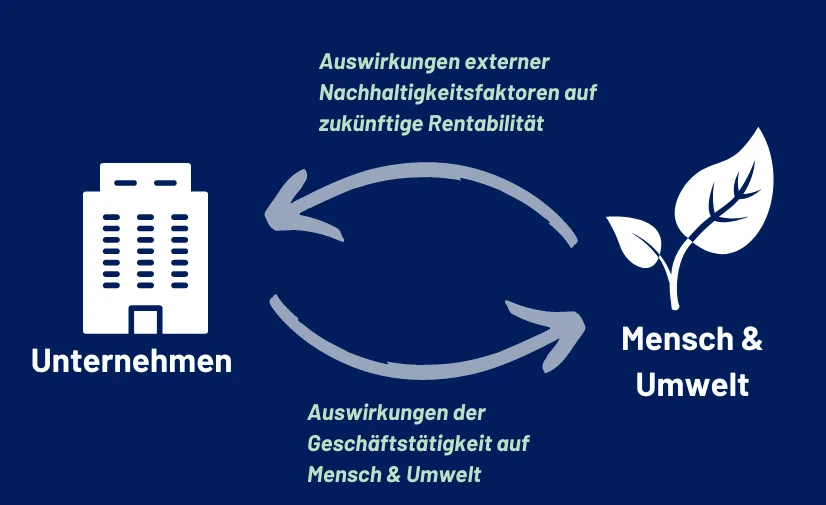
Accordingly, a sustainability aspect must be reported if it is classified as material from at least one of the two perspectives. Previously, aspects only had to be reported if both materiality aspects were met.
You can find more information on this in our article on the sustainability materiality assessment.
In addition to double materiality, companies subject to reporting must take into account the green financial key figures of the Taxonomy Regulation (EU 2020/852). They must explain how and to what extent their activities – in terms of turnover and capital and operating expenditure – are associated with economic activities that are considered environmentally sustainable under the regulation.
How must reporting be done under the CSRD?
The EU sustainability reporting standards
The content of sustainability reports under the CSRD is prescribed by the European Sustainability Reporting Standards (ESRS).
The following quantitative and qualitative information is specified:
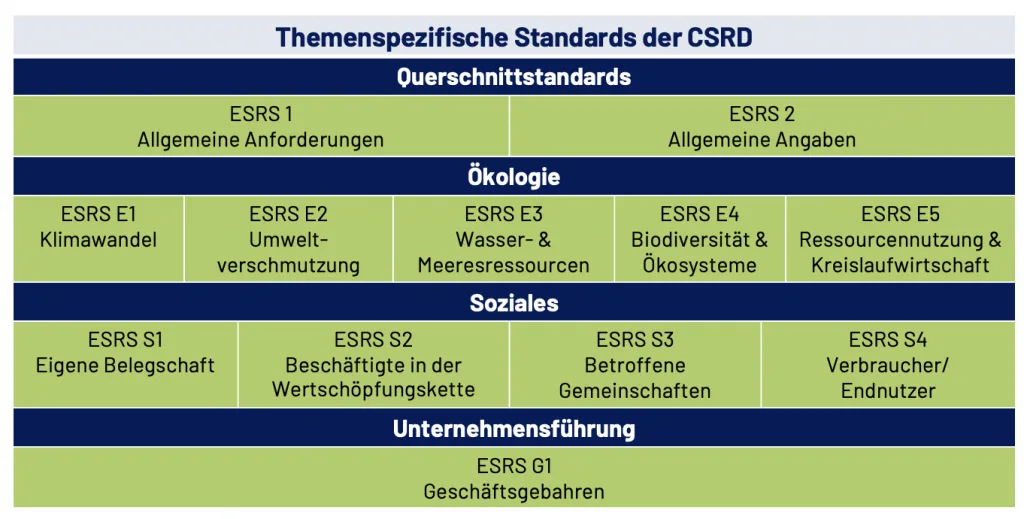
The CSRD specifies that all companies must report according to ESRS 2 (general disclosures). For companies with 250 or more employees, ESRS E1 (climate change) and ESRS S1 (own workforce) are added.
The double materiality analysis determines which other standards are relevant for a company and must therefore be met in reporting. These must then be reported in full. Materiality is confirmed by an external auditor.
This sustainability information must be presented in the management report and combined with digital tagging. The sustainability report can therefore no longer be published separately.
Telusio’s view
The CSRD represents a significant step towards more sustainable and transparent business practices. Companies should use this opportunity to improve their sustainability strategies and prepare for the upcoming reporting obligation.
Although not all data points need to be addressed, a considerable number of data points still have to be collected. From 1 January 2026, many companies will be affected by the new reporting obligation and must report on 2025. It is therefore strongly recommended to take care of the relevant data points as early as 2024 and to use 2025 as a test and practice year.
Companies should therefore start adapting their internal processes and systems early to meet the new requirements. This can include implementing ESG software solutions and training employees.
By understanding and applying this information about the CSRD, you can ensure that your company is well prepared for the future challenges of sustainability reporting.




Your customer is asking for a PCF?Let’s talk.
Discover the easiest way to audit-ready PCFs – AI-powered and expert-reviewed.
Book an initial call