
Blog
Insights from PCF practice
Studies, analyses and experience from projects with industrial companies.Articles are currently available in German only.
Articles are currently available in German only.
From the 2024 financial year, the EU Taxonomy Regulation brings significant changes that present companies and investors with new challenges and opportunities. The extended package of measures not only updates the existing climate objectives but also introduces new technical screening criteria for four additional environmental objectives. Increasing the number of technical screening criteria also means that significantly more economic activities are now taxonomy-eligible than before. This comprehensive extension promises a profound transformation in the way sustainability is measured and reported. The package thus becomes a central tool for companies that want to hold their own in an increasingly environmentally conscious economy.
What is the EU Taxonomy?
The EU Taxonomy Regulation is a classification and transparency instrument. Companies subject to reporting state it either in their financial statement or in their sustainability report. It helps companies and investors find out which economic activities are genuinely environmentally sustainable by defining what counts as environmentally sustainable and ensuring uniform criteria for assessing this sustainability. This makes companies and investments easier to compare, bringing more clarity and transparency. The regulation promotes environmentally friendly investment and supports the goals of the EU Green Deal by creating a uniform standard for sustainability.
What are the environmental objectives?
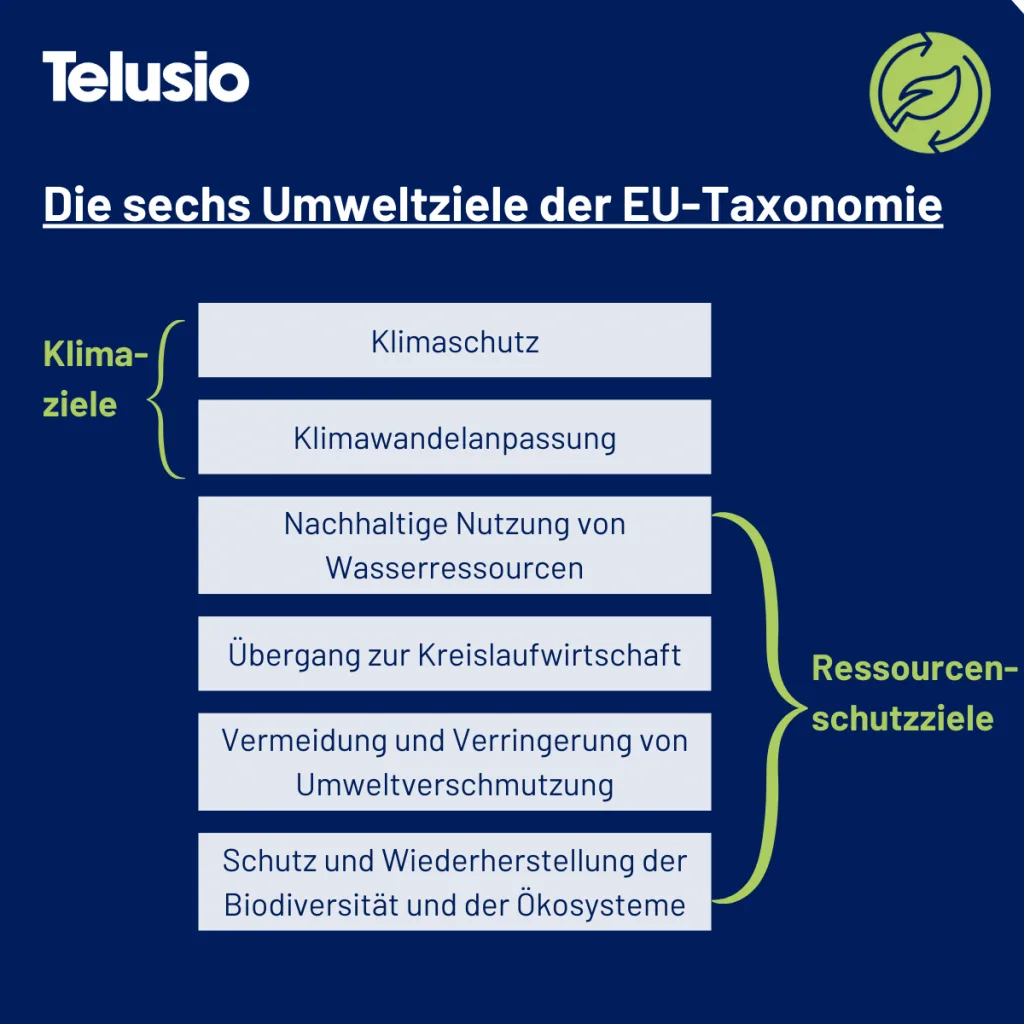
There are six environmental objectives in total, set out in Art. 9 of the EU Taxonomy Regulation.
They serve to establish clear criteria and standards for assessing environmentally sustainable economic activities.
How does an assessment based on the EU Taxonomy work in general?
The EU Taxonomy distinguishes fundamentally between taxonomy-eligible and taxonomy-aligned economic activities.
The first step for every company subject to reporting is to identify the economic activities that are taxonomy-eligible. As soon as an economic activity can be assigned to a technical screening criterion, it is taxonomy-eligible. The technical screening criteria are adopted by the EU Commission in delegated regulations. To proceed in a targeted way, the EU chose sectors with a very high footprint in the first published technical screening criteria. If an economic activity is not part of the technical screening criteria, it cannot be included.
If a technical screening criterion exists, an activity can be considered taxonomy-aligned after checking the following conditions:
An economic activity is taxonomy-aligned if it…
– makes a substantial contribution to at least one environmental objective
– does not significantly harm one or more environmental objectives
– complies with defined (social) minimum safeguards
As soon as the alignment level is reached and all three criteria are therefore met, an economic activity is considered environmentally sustainable. To check the first two of the three criteria, it is essential to examine the annexes of the respective delegated regulations, as they contain the technical screening criteria that must be met to comply with these criteria.
The new package significantly extends the technical screening criteria.
Changes for the 2024 financial year – new delegated regulations come into force
What was the previous status (since 2022)?
Until now, there were technical screening criteria only for the first two environmental objectives, the so-called climate objectives. These were published in the so-called “Climate Delegated Act” (Delegated Regulation (EU) 2021/2139) . Delegated Regulation (EU) 2022/1214, which focuses in particular on nuclear and gas energy, extended the Climate Delegated Act to these sectors.
As a result, companies could not base their sustainability reporting on activities that did not concern these objectives. This severely limited the overall assessment of their environmental sustainability, as well as the number of potentially taxonomy-eligible economic activities.
Changes from 2024
The restriction to the first two environmental objectives, the “climate objectives”, is now being lifted with the implementation of the new delegated regulations. From the 2024 financial year, all six environmental objectives are part of the technical screening criteria for companies. With the publication of a new package of measures in January 2024, the EU framework for sustainable finance is being further developed and strengthened, and the EU Commission is meeting the requirements of the EU Taxonomy Regulation. The package consists of two new delegated regulations that both revise the existing Climate Delegated Act and now also cover the four further environmental objectives, referred to below as “resource protection objectives”. This provides a range of new technical screening criteria.
Delegated Regulation 2023/2485 – focus on the “climate objectives”
Regulation 2023/2485 updates the Climate Delegated Act and introduces new technical screening criteria for the two climate objectives of the EU Taxonomy – climate change mitigation and climate change adaptation. This regulation, adopted on 27 June 2023, applies from 1 January 2024.
Delegated Regulation 2023/2486 – focus on the “resource protection objectives”
Regulation 2023/2486, published on 21 November 2023, supplements the EU Taxonomy by setting technical screening criteria for the four remaining environmental objectives: sustainable use and protection of water and marine resources, transition to a circular economy, pollution prevention and control, and protection and restoration of biodiversity and ecosystems. This regulation also amends the disclosure obligations of Delegated Regulation 2021/2178. It has also applied since 1 January 2024.
“The EU has come a long way in fostering sustainable finance. Today we are going a step further in completing the regulatory environment to incentivise the much-needed investment for sustainable growth. It’s crucial that existing rules and tools are coherent, user-friendly and work effectively in practice. At the same time, we want to ensure that all companies get finance to invest in their transition to sustainability. This is also important to boost long-term competitiveness of European companies and the European economy and fight climate change.”
– Valdis Dombrovskis, Executive Vice-President of the European Commission for “An Economy that Works for People”
So what does this mean for companies?
Changes to reporting obligations for the 2024 financial year
Non-financial companies
Non-financial companies must assess taxonomy eligibility and taxonomy alignment for all six environmental objectives. It is important to note that the climate objectives have been updated and extended, so they should be reassessed.
In a further step, non-financial companies must now present KPIs on achieving the climate objectives for all taxonomy-aligned activities. These are expressed in three key figures: in relation to turnover, capital expenditure (CapEx) and operating expenditure (OpEx). They are the central key figures for stakeholders and shareholders and form the basis of comparison for investors.
Financial companies
Unlike non-financial companies, financial companies only have to assess taxonomy alignment for the first two objectives, the so-called climate objectives. Here too, the new regulations should be reviewed, as the climate objectives have been extended and updated.
For all other resource protection objectives, an assessment of taxonomy eligibility is sufficient.
Extension of the group of users
With the CSRD coming into force in January 2023 and the gradual implementation of this directive, the group of companies applying the EU Taxonomy Regulation will also expand continuously.
The NFRD was the starting point for regulatory development in sustainability reporting in the EU. It is gradually being replaced by the CSRD to ensure more comprehensive and clearer reporting on sustainability aspects. The EU Taxonomy Regulation provides the framework and criteria for objectively assessing and comparing companies’ sustainability performance. Companies covered by the NFRD, in particular Art. 19a and 29a, must publish non-financial reporting in line with the EU Taxonomy. As the NFRD is being replaced by the CSRD, companies obliged under the EU Taxonomy are also gradually falling under the CSRD.
In addition, the thresholds for defining large companies change from 2024 under the CSRD, which means more companies will apply the EU Taxonomy. For more information on the CSRD timeline, click here.
Telusio’s view
From 2024, companies must assess their activities under the EU Taxonomy not only for climate protection but also for four new environmental objectives. These cover water resources, the circular economy, pollution and biodiversity. Companies must assess their activities for taxonomy eligibility and alignment in accordance with the EU’s technical criteria. In addition, extended reporting obligations are being introduced, such as disclosing key figures on turnover, capital expenditure and operating expenditure in relation to sustainable activities. Companies should adapt their sustainability reporting to meet the new requirements.


Your customer is asking for a PCF?Let’s talk.
Discover the easiest way to audit-ready PCFs – AI-powered and expert-reviewed.
Book an initial call