
Blog
Insights from PCF practice
Studies, analyses and experience from projects with industrial companies.Articles are currently available in German only.
November 28, 2024 · 8 min read · Dr. Johannes Weibl
Carbon Footprints: The Key to Sustainable Business Success
Articles are currently available in German only.
Carbon footprints are a crucial tool for companies that want to actively take on their environmental responsibility and meet long-term climate targets, such as an SBTi commitment. Whether to meet legal requirements or as part of a comprehensive sustainability strategy, the precise recording and analysis of greenhouse gas emissions provides valuable insights and strategic starting points.
This article explains the differences between Corporate and Product Carbon Footprints (CCF and PCF) and shows how companies can record their emissions systematically and design climate strategies effectively.
What are carbon footprints?

Carbon accounting, also known as CO₂ accounting or carbon footprinting, comprises systematic methods for recording, calculating, assessing and monitoring greenhouse gas (GHG) emissions generated within a process.
These emissions are expressed in CO₂ equivalents (CO₂e) in order to cover greenhouse gases such as methane that cannot be measured directly as CO₂. As different greenhouse gases contribute to climate change to different degrees, expressing them in CO₂ equivalents enables a comparable and uniform representation of their harmfulness. Based on the Kyoto Protocol, the GHG Protocol limits GHG emissions to seven greenhouse gases, including carbon dioxide (CO₂), methane (CH4), nitrous oxide (N₂O) and other environmentally harmful gases.
Carbon footprints also help governments develop national climate strategies and form a basis for new laws. They are also an essential instrument for complying with international agreements. The Paris Agreement is particularly important for EU countries, as it sets clear emission reduction targets that can only be met if individual countries know their annual GHG emissions.
What is a carbon footprint used for?
Companies carry out a carbon footprint to determine the GHG emissions they cause, which makes it possible to identify key areas with particularly high savings potential.
Carbon footprints help companies set new environmental targets, develop climate strategies and achieve sustainability goals. They also create a competitive advantage in dynamic markets and can meet legal and international requirements. Under certain circumstances, carbon accounting is already mandatory today. Current developments within the EU clearly show a trend towards more detailed reporting and more precise carbon accounting. This is crucial, as obligations to provide evidence to legal authorities, stakeholders and shareholders are increasing. A rough estimate of emissions is no longer sufficient; precise, quantitative calculation methods are indispensable today.
To assess and exploit this savings potential, it must be understood which company activities contribute how much to the emissions released. The distinction between Scope 1, 2 and 3 of the GHG Protocol can be applied for this. Carbon footprints also help a company meet non-financial disclosure obligations, as they provide a valid benchmark against which precise emission reduction targets can be defined.
What are Scope 1, 2 and 3?
The division of GHG emissions into three different categories is based on the Greenhouse Gas Protocol (hereinafter: GHG Protocol). Here is a brief overview of the three categories:
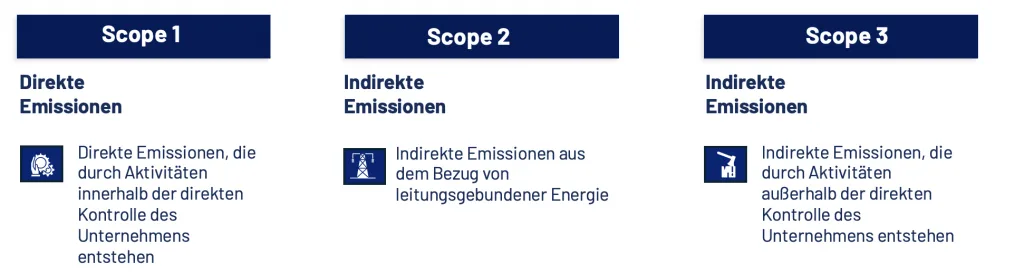
Scope 1: direct emissions
Scope 1 covers all direct emissions caused by a company. This includes all energy consumption arising “in-house”, for example the consumption of natural gas for heating production facilities. These emissions can usually be identified quickly and calculated precisely, especially if an energy management system is already established in the company. The company’s influence is particularly great here.
Scope 2: indirect emissions (energy)
Scope 2 covers all indirect emissions arising from purchased energy – i.e. electricity, steam, heat and cooling supplied by third parties. These emissions are not caused directly within the company itself, which means the sphere of influence is smaller.
Scope 3: indirect emissions (upstream and downstream)
Scope 3 covers all emissions that arise along the value chain outside the company’s direct sphere of influence. This includes emissions caused before the raw materials arrive at the company (upstream) as well as those arising after the final products leave, during their use or disposal (downstream).
Examples include emissions from suppliers’ logistics or from product disposal. Upstream emissions in the supply chain in particular usually account for the largest share of a company’s total emissions, often more than 70%. Precisely recording and quantifying these emissions is therefore of central importance for achieving corporate sustainability goals. However, calculating Scope 3 emissions is challenging, as it often requires collecting detailed data from external partners such as suppliers.
More detailed information can be found in our insights article on the GHG Protocol.
What is the difference between a carbon footprint at company or product level?
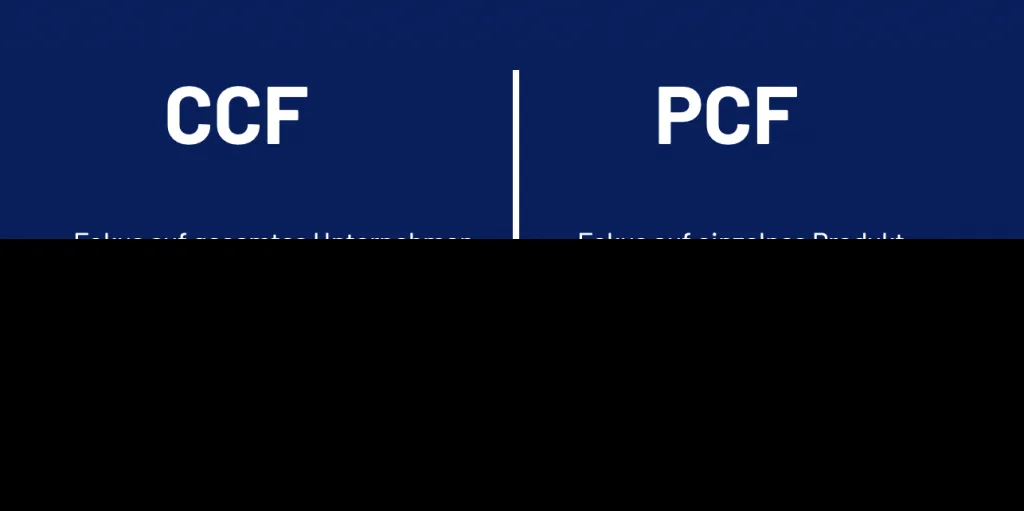
Product Carbon Footprint (PCF)
When calculating the carbon footprint at product level, all emissions directly or indirectly associated with the production of the product are determined. The entire life cycle of a product is considered and every activity along the value chain is identified.
Quantifying the PCF often makes emissions more tangible and is ideal for communicating with customers. More information can be found in our insights article on PCF calculation.
Corporate Carbon Footprint (CCF)
When calculating the carbon footprint at company level, all emissions directly or indirectly associated with the company are considered. These include, for example, employees’ commuting emissions or emissions from the logistics of purchased goods, as well as the emissions of the purchased goods themselves. These emissions are not broken down to an individual product, but summed up across all internal and external processes.
Ideally, the CCF, just like the PCF, is calculated across all three scopes (1–3). However, calculating Scope 3 emissions is not mandatory for many companies. Whether there is a reporting obligation can be found in the CSRD (Corporate Sustainability Reporting Directive). Every company is free to include Scope 3 voluntarily, and this is recommended, as Scope 3 emissions usually make up the majority of the CCF.
How should carbon accounting be carried out?
1. Basic framework
First, it must be clarified whether carbon accounting is to be carried out for the entire company (= Corporate Carbon Footprint) or for a single product/several products (= Product Carbon Footprint). Depending on the choice, different data is recorded in the later steps: either for the entire company or specifically for one or more products. In addition, the organisational boundaries must be defined: which business units and sites are included in the accounting. The period for data collection must also be set.
2. Objective
The next step is to check whether specific requirements or disclosure obligations need to be considered when choosing the method. If such rules exist that specify which emissions are to be included in the calculation, they must be taken into account. The environmental and sustainability goals set by the company and its long-term strategy should be considered in particular.
3. System boundaries: PCF and CCF
For a PCF calculation, it is crucial to define which section of the product life cycle (so-called system boundaries) is to be considered (e.g. cradle-to-gate). The exception is a cradle-to-cradle analysis, as this covers the calculation of all emissions over the entire life cycle of the product. All other analyses consider sections of the life cycle. In some cases, the type of analysis may already be prescribed by disclosure obligations. Determining the system boundaries is a relevant step, as it clearly defines the scope of the calculation.
For the CCF calculation, similarly to the PCF calculation, it must be defined which scopes are considered. Including Scope 1 and 2 is mandatory. Whether Scope 3 is included depends on the respective company’s non-financial disclosure obligations. In some cases, only certain parts of Scope 3 may be considered. Unlike the PCF calculation, which applies distinctions in system boundaries such as gate-to-cradle, such a distinction is not required for the CCF calculation.
4. Choice of method
There are various methods for drawing up a carbon footprint (e.g. the activity-based method). Depending on the choice of method, different costs and benefits arise that have to be weighed up. The collection effort (costs, expertise and time) also varies greatly between methods.
5. Data collection
Depending on the chosen method, the corresponding data must now be collected. If primary data is available, its quality should first be validated. If it meets the requirements, it can be used.
6. Calculating the emissions
The emission calculation is largely determined by the choice of method. The determined activities are assigned to the corresponding emission factors. The results are expressed in CO₂e and assigned to the respective scopes.
7. Compiling the balance
The individual emissions from the various scopes are now combined to create the overall carbon footprint.
8. Reviewing and validating the balance
Companies subject to legal obligations must have their carbon footprint reviewed by an independent third party to ensure its accuracy and compliance with applicable standards.
9. Developing measures and continuous optimisation
Once the emission sources have been clearly identified, targeted measures to reduce greenhouse gases can be developed and implemented. The carbon footprint should be updated regularly to measure progress and set new targets.
Creating a carbon footprint requires precision, expertise and often the use of specialised software. It is a continuous process that delivers a lot of relevant data and demonstrates the company’s commitment to ongoing monitoring and improvement of its environmental performance.
Telusio’s view
With solid carbon accounting, companies can not only reduce their emissions but also develop sustainable measures that save costs in the long term and improve the company’s external image.
Carbon footprints should be understood as a strategic instrument that not only serves to meet regulatory requirements but also creates considerable competitive advantages and systematically drives the company’s sustainable orientation.


Your customer is asking for a PCF?Let’s talk.
Discover the easiest way to audit-ready PCFs – AI-powered and expert-reviewed.
Book an initial call