
Blog
Insights from PCF practice
Studies, analyses and experience from projects with industrial companies.Articles are currently available in German only.
Articles are currently available in German only.
What is the Product Carbon Footprint (PCF)?
The Product Carbon Footprint (PCF) shows the individual carbon dioxide footprint of a product and thus provides insight into the climate impact along the entire value chain.
According to the ISO 14067 standard, the PCF comprises
“the sum of greenhouse gas emissions and removals in a product system, expressed as CO2 equivalents and based on a life cycle assessment using the single impact category of climate change”.
Calculating a PCF is usually complex and time-consuming, as the emissions of various greenhouse gases along the entire life cycle of a product must be taken into account. This includes not only carbon dioxide (CO2) but also methane (CH4), nitrous oxide (N2O), sulphur hexafluoride (SF6), nitrogen trifluoride (NF3), hydrofluorocarbons (HFCs) and perfluorocarbons (PFCs).
The emissions are converted into CO2 equivalents (CO2e) using the global warming potential, which indicates how much one tonne of a greenhouse gas contributes to climate change compared to one tonne of CO2.
This calculation can be based on either financial expenditure or the company’s actual activities .
System boundaries of the Product Carbon Footprint
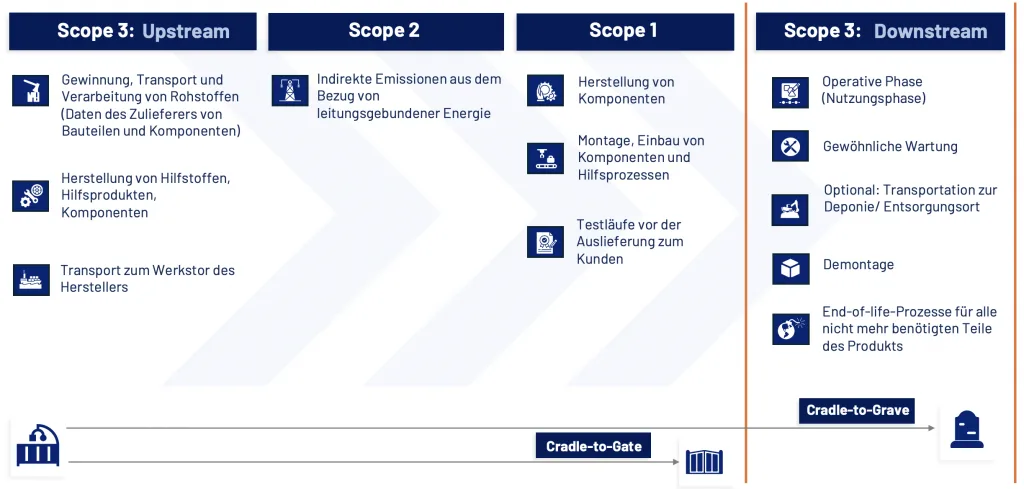
When calculating the Product Carbon Footprint (PCF), all life cycle stages can be included.
Basically, two accounting principles are distinguished: cradle-to-gate (from the cradle to the factory gate) and cradle-to-grave (from the cradle to the grave).
- Cradle-to-gate: the cradle-to-gate PCF shows all emissions caused from raw material extraction to the completion of the product.
- Cradle-to-grave: in addition to the emissions of the cradle-to-gate approach, the cradle-to-grave PCF measures the emissions generated during product use and disposal.
Which standards must be considered when calculating the Product Carbon Footprint (PCF)?
A product-specific carbon footprint (PCF) is calculated according to various standards and guidelines. These include PAS 2050, the Greenhouse Gas Protocol and ISO 14067. These standards offer different approaches and methods for calculating the Product Carbon Footprint and quantifying greenhouse gas emissions.
PAS 2050, first published by the British Standards Institution (BSI) in 2008 and revised in 2011, provides a framework for quantifying greenhouse gas emissions along the product life cycle. The standard is based on ISO 14044 and aims to promote more sustainable products.
The Greenhouse Gas Protocol (2011), developed by the World Resources Institute (WRI) and the World Business Council for Sustainable Development (WBCSD), is largely based on PAS 2050 and ISO 14044. It sets an international standard for calculating product-related greenhouse gas emissions and sets requirements for accounting and reporting.
ISO 14067, last updated in 2018, is based on various ISO standards and introduces clear quantification rules. The standard enables different materials from the same category to be compared and sets requirements for calculating greenhouse gas emissions for a product.
The standards differ in their scope and in how they account for biogenic carbon. While both PAS 2050 and the GHG Protocol set requirements for quantifying the greenhouse gas impact of a product over its lifetime, PAS 2050 includes additional requirements for recording emissions.
If CO2 is absorbed along the value chain, PAS 2050 and the GHG Protocol require accounting in which this amount is deducted. In contrast, ISO 14067 requires it to be reported separately.
Telusio’s view
With the Product Carbon Footprint (PCF), companies can trace in detail the extent to which greenhouse gases are released in the manufacture, use and disposal of a product or service.
As our PCF Study 2024 shows, there are numerous reasons for producing such a product-specific balance, such as customer needs, company-wide net-zero targets or regulation.
Telusio’s approach takes into account all processes along the value chain, from manufacturing through transport and production to distribution and waste disposal. Using activity-based quantification, a detailed Product Carbon Footprint can be created for a product within a short time. This allows you to communicate science-based sustainability management and optimise your CSR strategy.


Your customer is asking for a PCF?Let’s talk.
Discover the easiest way to audit-ready PCFs – AI-powered and expert-reviewed.
Book an initial call