
Blog
Insights from PCF practice
Studies, analyses and experience from projects with industrial companies.Articles are currently available in German only.
October 31, 2024 · 3 min read · Dr. Johannes Weibl
Challenges of Calculating Scope 3 Emissions
Articles are currently available in German only.
Recording greenhouse gas emissions is an essential part of a company’s sustainability strategy. While calculating Scope 1 and Scope 2 emissions – a company’s direct and energy-related emissions – is clearly defined and comparatively easy to implement, recording Scope 3 emissions is often a greater challenge.
Scope 3 covers all indirect emissions arising along the value chain, from sourcing raw materials to the use and disposal of products. These emissions often account for the largest part of a company’s CO₂e footprint, with estimates suggesting they can make up 70–80% of total emissions.
Why is Scope 3 calculation so difficult?
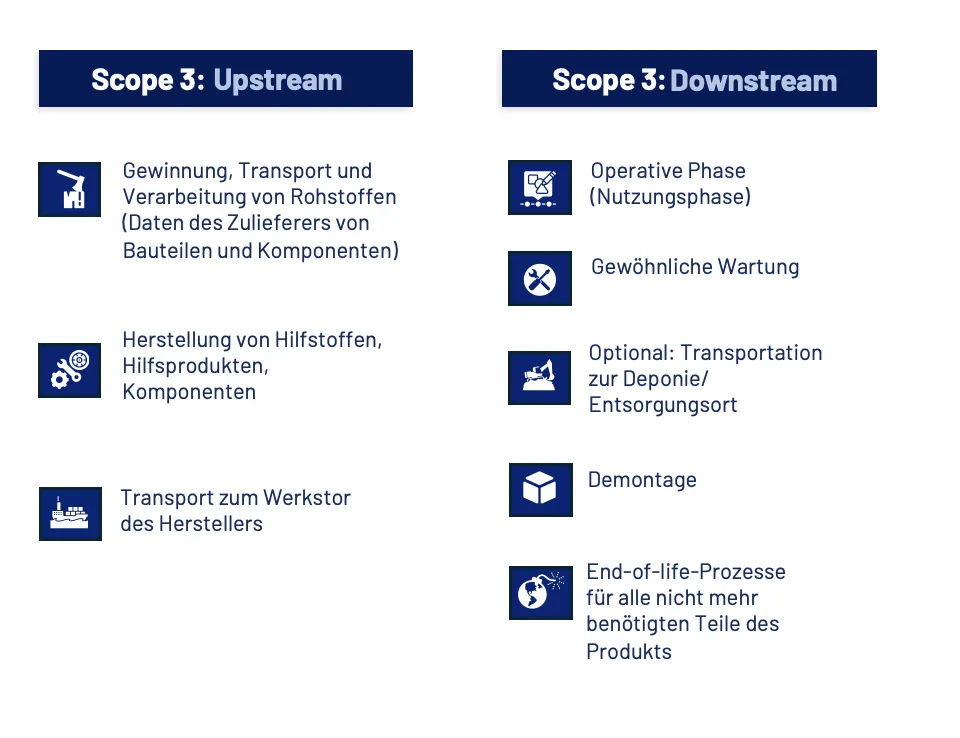
The complexity of recording Scope 3 emissions according to the GHG Protocol results from the large number of sources and the indirect nature of these emissions. They comprise 15 categories, divided into upstream and downstream emissions (see graphic). These include purchased goods and services, transport, business travel, waste management and even the use of sold products.
Missing primary data
A central challenge is that companies often struggle to obtain reliable and complete data from their suppliers. Only a small share of suppliers can provide specific primary data on the CO₂ emissions of their products. Without this information, companies are forced to rely on secondary data or make assumptions based on averages. These data gaps lead to inaccurate calculations and make it harder to produce robust Scope 3 reports.
Data gaps in internal master data
Another obstacle is the quality of the master data available within the company. Information on materials, weights or suppliers is often incomplete or hard to access, which makes calculating CO₂e emissions even more difficult. To quantify Scope 3 emissions correctly, all relevant data on purchased goods and services and their transport and processing must be available. But managing and analysing these data volumes can be an enormous administrative effort.
Closing data gaps efficiently and pragmatically: TELUSIO Intelligence
TELUSIO Intelligence offers companies an innovative solution for calculating Scope 3 emissions accurately and efficiently, even when there are data gaps or primary data from suppliers is missing.
1. Automated data preparation

TELUSIO Intelligence detects and fills in missing or incomplete master data using existing databases, industry standards and machine learning. This allows companies to calculate their Scope 3 emissions more efficiently without time-consuming manual research or supplier requests.
2. Primary data management
TELUSIO also supports companies in collecting and managing primary data. Targeted supplier management and integrating this data into the calculations improve the accuracy of emission reports. Companies can thus ensure they meet the requirements of regulations such as the Corporate Sustainability Reporting Directive (CSRD).
3. Comprehensive calculations for complex products
Not only simple manufactured parts but also complex products consisting of several components can be analysed and calculated in detail with TELUSIO Intelligence. This enables companies to close all data gaps and draw correct conclusions about Scope 3 emissions.
Telusio’s view
Calculating Scope 3 emissions is one of the biggest challenges in the sustainable management of CO₂e emissions. With TELUSIO Intelligence, companies get a powerful tool that not only closes data gaps but also helps make emission calculations more efficient and precise. This is particularly important as regulatory requirements such as the CSRD are increasingly making Scope 3 reporting mandatory.
Are you ready to tackle your Scope 3 emissions and do business more sustainably? Contact us and find out how TELUSIO can support your company in calculating and optimising its carbon footprint.


Your customer is asking for a PCF?Let’s talk.
Discover the easiest way to audit-ready PCFs – AI-powered and expert-reviewed.
Book an initial call