
Blog
Insights from PCF practice
Studies, analyses and experience from projects with industrial companies.Articles are currently available in German only.
Articles are currently available in German only.
As part of global efforts to combat climate change, initiatives such as the Science Based Targets are becoming increasingly important. Science Based Targets were developed by the Science Based Targets initiative (SBTi) in close collaboration with more than 800 stakeholders. The initiative is a partnership between CDP (formerly the Carbon Disclosure Project), the UN Global Compact, the World Resources Institute (WRI) and WWF.
For companies that commit to these targets, carbon accounting – the systematic recording and calculation of CO2 emissions – is an indispensable tool. The targets offer a clear and measurable path to reducing greenhouse gas emissions. They were developed to give companies clear guidelines for reducing their greenhouse gas emissions in order to prevent the most damaging effects of climate change and limit global warming to 1.5 degrees Celsius.
As emissions in Scope 3 of the GHG Protocol often account for the largest share of a company’s total emissions, precise calculation of these emissions is essential to meet the requirements of the Science Based Targets initiative (SBTi). Companies must therefore not only consider their direct emissions (Scope 1 and 2) but also ensure that they develop and implement a sound methodology for calculating and reducing Scope 3 emissions.
How do Science Based Targets work?
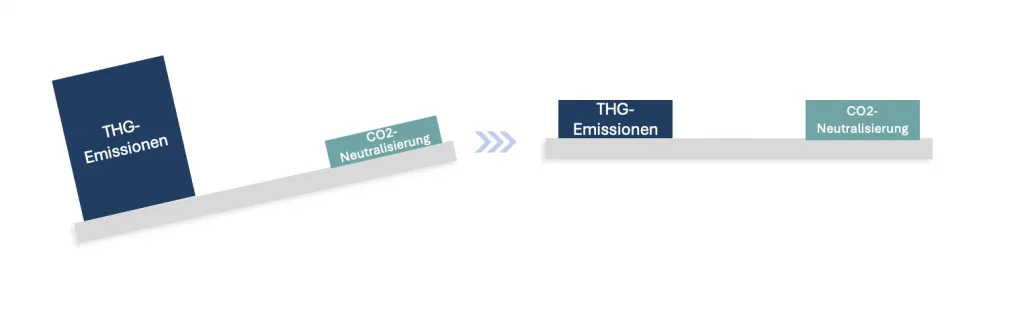
Companies that commit to the Science Based Targets (and pursue both short- and long-term targets) must disclose their emissions annually throughout the reduction process to create transparency for stakeholders.
Science Based Targets are usually set in two steps:
- Determining the reduction target: companies analyse their greenhouse gas emissions according to Scopes 1, 2 and 3 of the GHG Protocol. Ambitious targets for reducing these emissions are then set, which in principle cover Scope 1 and 2. If more than 40% of a company’s total emissions fall under Scope 3, these emissions must also be included in the target. This target is based on scientific criteria provided by the SBTi.
- Implementation and monitoring: companies develop strategies and measures to achieve their reduction target and regularly monitor their progress. The SBTi offers support and resources to help companies achieve their targets and monitor their progress.
What needs to be considered when setting targets?
There are two different types of targets in total: near-term SBTs and long-term net-zero targets.
Near-term Science Based Targets ensure that a company pursuing the Science Based Targets takes short-term action to reduce emissions at a pace consistent with limiting warming to below 1.5 degrees Celsius. The time frame here is between 5 and 10 years.
Long-term net-zero targets, on the other hand, provide a framework for defining the company’s long-term strategic and financial decisions in line with the 1.5 degree Celsius target. For most companies, this means cutting emissions by around 90% by 2050. The remaining emissions, together with the neutralisation of emissions, then make up a company’s net-zero strategy.
Further information can be found on the SBTi website.
Why are Science Based Targets relevant for companies?
Science Based Targets are relevant for companies for several reasons:
- Clear guidance: Science Based Targets give companies a clear and defined guideline on how much and how quickly they need to reduce their greenhouse gas emissions to prevent the worst effects of climate change and limit global warming to 1.5 degrees Celsius. This helps companies plan and implement their climate targets strategically.
- Transparency and accountability: companies that commit to Science Based Targets must make calculations of their current emissions and publicly disclose their progress in reducing their greenhouse gas emissions. This increases transparency and accountability towards investors, customers and other stakeholders.
- Competitiveness and sustainability: companies that commit to Science Based Targets demonstrate their commitment to climate protection and position themselves as pioneers in their industries. This can improve their image and create new business opportunities by positioning themselves as sustainable and responsible companies.
Telusio’s view
For manufacturing companies, Scope 3 emissions often account for the largest share of their total emissions – frequently more than 40%. This means that calculating and reducing these emissions in line with the Science Based Targets is indispensable. Purchased goods and services, transport and distribution in particular contribute significantly to Scope 3 emissions.
The challenge, however, is that companies often struggle with data gaps when calculating Scope 3 accurately. This affects both the quality of master data and missing primary data from suppliers, which is necessary for sound carbon accounting.
This is where TELUSIO comes in. Our AI-based solution helps companies close these gaps by supplementing relevant data and preparing it in compliance with current regulations. This enables companies to produce more reliable carbon footprints, which are necessary for achieving their Science Based Targets.



Your customer is asking for a PCF?Let’s talk.
Discover the easiest way to audit-ready PCFs – AI-powered and expert-reviewed.
Book an initial call