
Blog
Insights from PCF practice
Studies, analyses and experience from projects with industrial companies.Articles are currently available in German only.
March 18, 2026 · 4 min read · Dr. Johannes Weibl
Why 80% of Product Carbon Footprints (PCF) Fail Because of the Bill of Materials
Articles are currently available in German only.
The discussion around Product Carbon Footprints (PCF) is often framed as a methodological challenge. Yet standards such as ISO 14067 or the GHG Protocol have long been established. In practice, a different picture emerges: the bottleneck is not the calculation but the data basis. More precisely – the bill of materials.
For sustainability managers, LCA specialists and those responsible for product compliance, the BOM (bill of materials) thus becomes a critical success factor. Without a reliable structure here, you will not produce a reliable PCF.
1. PCF is primarily a data problem
A PCF is only as good as the data it is based on. While the methodological side is standardised and auditable, the data situation in companies often remains fragmented, incomplete and not designed for sustainability assessments.

85% of respondents in this year’s PCF study (2026), conducted together with LMU Munich, state that 15% or fewer of all their suppliers provide primary data – a considerable share of them ≤ 5%
This leads to a structural problem:
The entire PCF pipeline – from data collection through modelling to reporting – is only as stable as its weakest link. And in most cases, that link is the bill of materials.
2. Typical problems with bills of materials
 1. Incomplete data
Many bills of materials (BOMs) lack relevant components or key attributes. Small parts, packaging or electronic components are often not fully recorded. Even more critical: weights, material specifications or supplier information are often missing.
The result is a systematic under-recording of emissions – and thus a distorted overall picture.
2. Wrong or overly coarse material classification
Material specifications such as “plastic” or “metal” are sufficient for production but useless for a carbon footprint. Without differentiation – for example between ABS, polycarbonate or glass-fibre-reinforced plastics – no reliable emission factors can be assigned.
Equally problematic is the lack of distinction between primary and secondary materials, especially for metals.
3. Inconsistent data structures
In practice, there are often several data sources: ERP, PLM, Excel lists. Materials are named differently, structures are not harmonised, and there is no uniform system.
The result is a high manual effort for LCA specialists – and an increased risk of errors.
4. Outsourcing as a structural data risk
Due to the long-term outsourcing of production – especially to Asia – many companies today lack a reliable data basis. Bills of materials are incomplete, fragmented or simply no longer available, because knowledge about materials and processes lies outside the company’s own organisation.
Classic data enrichment falls short here. What is needed are intelligent PCF/BOM solutions that can reconstruct missing structures and handle uncertainty. At the same time, this trend will continue to intensify – while requirements for transparency keep rising.

Implications for organisation and management
The consequences are clear:
- High coordination effort between functions
- Loss of data sovereignty over your own products
- Limited ability to make decisions
Used correctly, however, the PCF topic can become a lever to regain transparency and strengthen control along the value chain.
3. Why classic bills of materials (BOMs) are not PCF-ready
The cause lies in the original purpose of the bill of materials. A classic bill of materials (BOM) is geared towards production, purchasing and cost optimisation – not sustainability.
Three central dimensions are missing:
- Ecological connectivity: no standardised link to LCA databases
- Granularity: aggregated assemblies instead of a material-level breakdown
- Material depth: no differentiation within components
The classic bill of materials (BOM) is therefore functionally correct – but does not reflect sustainability requirements.
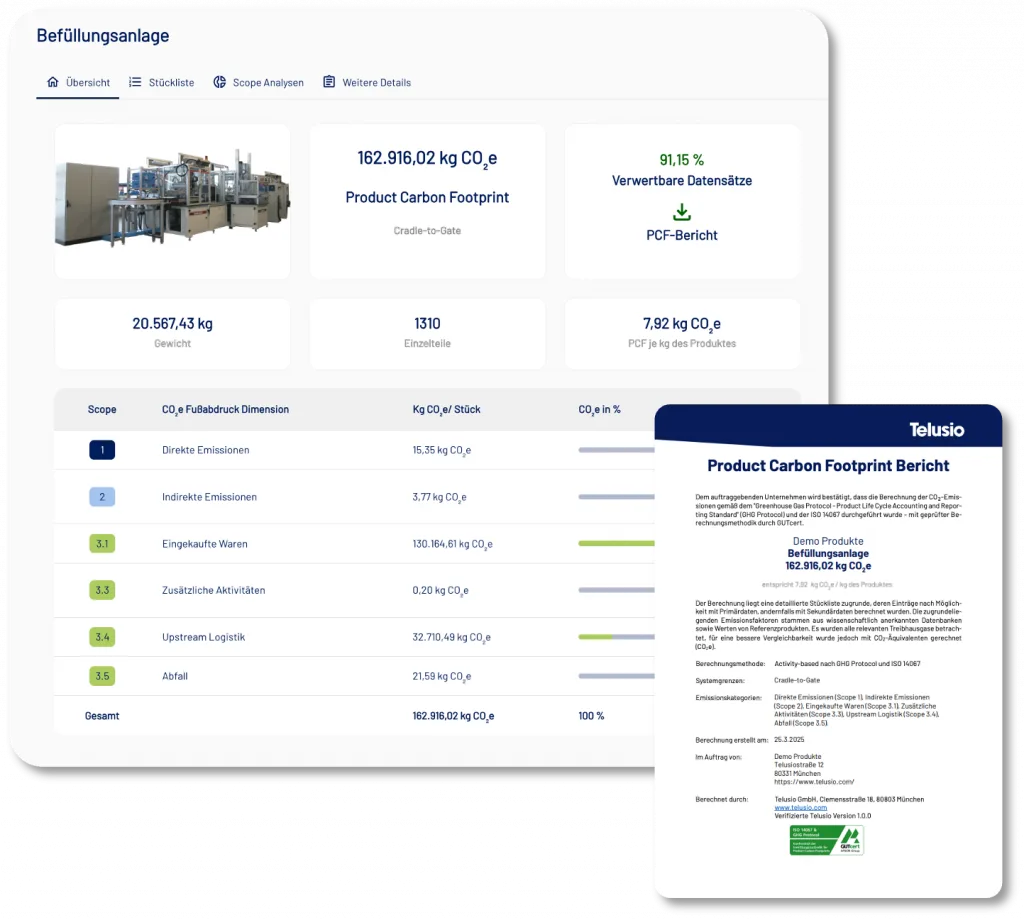
4. Practical example: when data is missing, the PCF becomes useless
A typical scenario from practice:
An electronic product is to be assessed. The bill of materials contains:
- No weights for circuit boards
- Material specifications such as “metal” without further detail
- Plastic components without a type definition
As a result, assumptions have to be made: average values, proxy data or estimates. Uncertainty quickly rises to ±30 to 50 percent.
For management, this means:
- ESG reports become vulnerable
- Product comparisons lose their significance
- Audits become a risk
A PCF without a reliable bill of materials (BOM) is only a rough approximation – not a basis for decisions.
5. Solution: the structured bill of materials (BOM) as an enabler
The key lever lies in systematically preparing the bill of materials. The goal is a “PCF-ready bill of materials (BOM)” that serves as a reliable data model.
 1. Standardising the data structure:
Clear definitions for:
- Material classes
- Weights
- Suppliers
- Process information
Uniform structures create comparability and scalability.
2. Material mapping:
Internal material names must be systematically mapped to LCA database entries. This requires:
- A central material catalogue
- Information on alloys
- Clear assignment logic
- Governance for maintenance and extension
3. Enriching missing data:
Not all data will be available immediately. What matters is handling this in a structured way:
- Rule-based or model-based weight estimates
- Integration of supplier data
- Use of secondary data with clear labelling
Transparency is more important than supposed precision.
4. Integration into existing systems:
In the long term, BOM preparation must be integrated into existing system landscapes:
- Linking ERP, PLM and sustainability tools
- Automation instead of manual Excel processes
- Continuous data maintenance instead of one-off projects
The bill of materials thus evolves from a cost instrument into a relevant data instrument for sustainability.
6. Before/after: what makes a PCF-ready bill of materials (BOM)
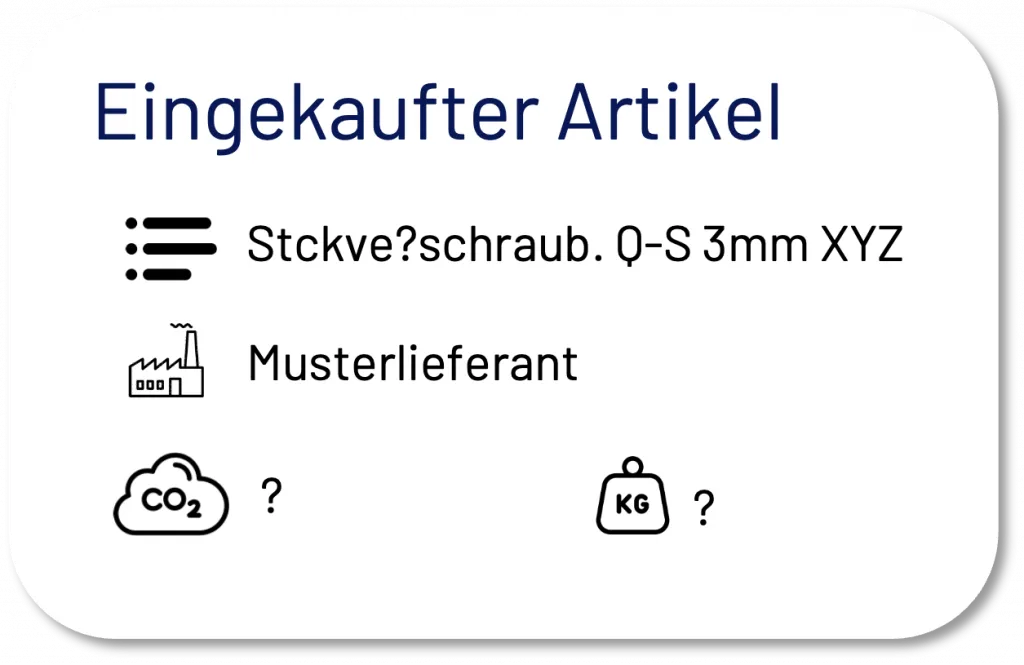
Before (classic bill of materials (BOM)):
Using a push-in fitting as an example:
- Material: “metal”
- Weight: not specified
- Structure: aggregated assemblies
- No link to emission data
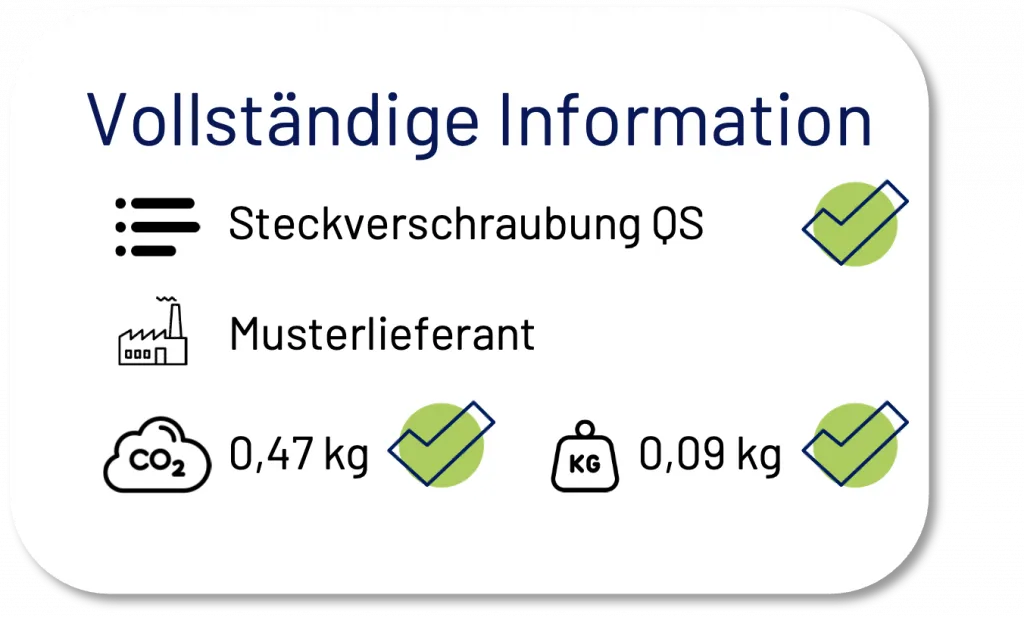
After (PCF-ready bill of materials (BOM)):
- Material: “unalloyed steel”
- Weight: 120 g
- Structure: component-level
- Link to emission factor (kg CO₂e/kg)
Telusio’s view: the bill of materials is both bottleneck and lever
In practice, around 80% of PCF initiatives fail not because of methodology or tools, but because of the quality of the bill of materials.
Companies that build their bill of materials (BOM) in a structured, PCF-ready way gain a clear advantage:
- reliable CO₂ data
- auditable reporting
- scalable processes
Investing in data quality therefore pays off directly in sustainability, compliance and competitiveness.


Your customer is asking for a PCF?Let’s talk.
Discover the easiest way to audit-ready PCFs – AI-powered and expert-reviewed.
Book an initial call