
Blog
Insights from PCF practice
Studies, analyses and experience from projects with industrial companies.Articles are currently available in German only.
July 22, 2025 · 9 min read · Dr. Johannes Weibl
Carbon Accounting in Focus: Why PCF and Embodied Carbon Both Matter
Articles are currently available in German only.
According to the Copernicus Climate Change Service, 2024 was the warmest year since records began. With the 1.5-degree threshold exceeded, the pressure to act on reducing greenhouse gases, especially carbon dioxide (CO2), becomes even clearer. The main sources of emissions include fossil energy generation, the transport sector and energy-intensive industrial processes. They are the focus of climate policy measures because they contribute significantly to global CO2 levels.
For companies, this means: looking only at operational emissions falls short. Operational emissions are those that arise directly within a company’s own sphere of responsibility (Scope 1 and 2). These include, for example, emissions from heating, company vehicles or office air conditioning. Emissions from upstream or downstream processes, such as the production of purchased materials by suppliers, are not taken into account.
To develop sound climate strategies, emissions along the entire value chain – from raw material extraction to use and disposal – must also be systematically recorded. The Product Carbon Footprint (PCF) and embodied carbon offer two established concepts for this, each capturing specific aspects of carbon accounting across the life cycle of a product, including buildings.
What to expect in this article:
This article explains the conceptual differences between PCF and embodied carbon, shows their practical relevance and gives an overview of how companies can use both approaches for effective carbon accounting.
1. What does “embodied carbon” mean?
“Embodied carbon” refers to the total amount of CO2 emissions generated during the life cycle of a product – i.e. during raw material extraction, manufacturing, transport, use and, where applicable, disposal. These emissions are often hard to see, yet they account for a considerable share of a product’s climate impact – especially for long-lasting and energy-intensive materials such as steel, cement or glass. Capturing them is a central part of modern carbon footprints, for example within a Product Carbon Footprint (PCF).
The term originally comes from construction and materials science, but is now also used in other industries, for example for accounting for consumer or capital goods. At first, it referred only to emissions arising before a product is used (upstream emissions). Today, the definition covers all system boundaries of life cycle assessment (LCA), as the definition of the World Green Building Council (WGBC) makes clear:
“Greenhouse gas emissions associated with materials and construction processes throughout the whole life cycle of a building or infrastructure.”
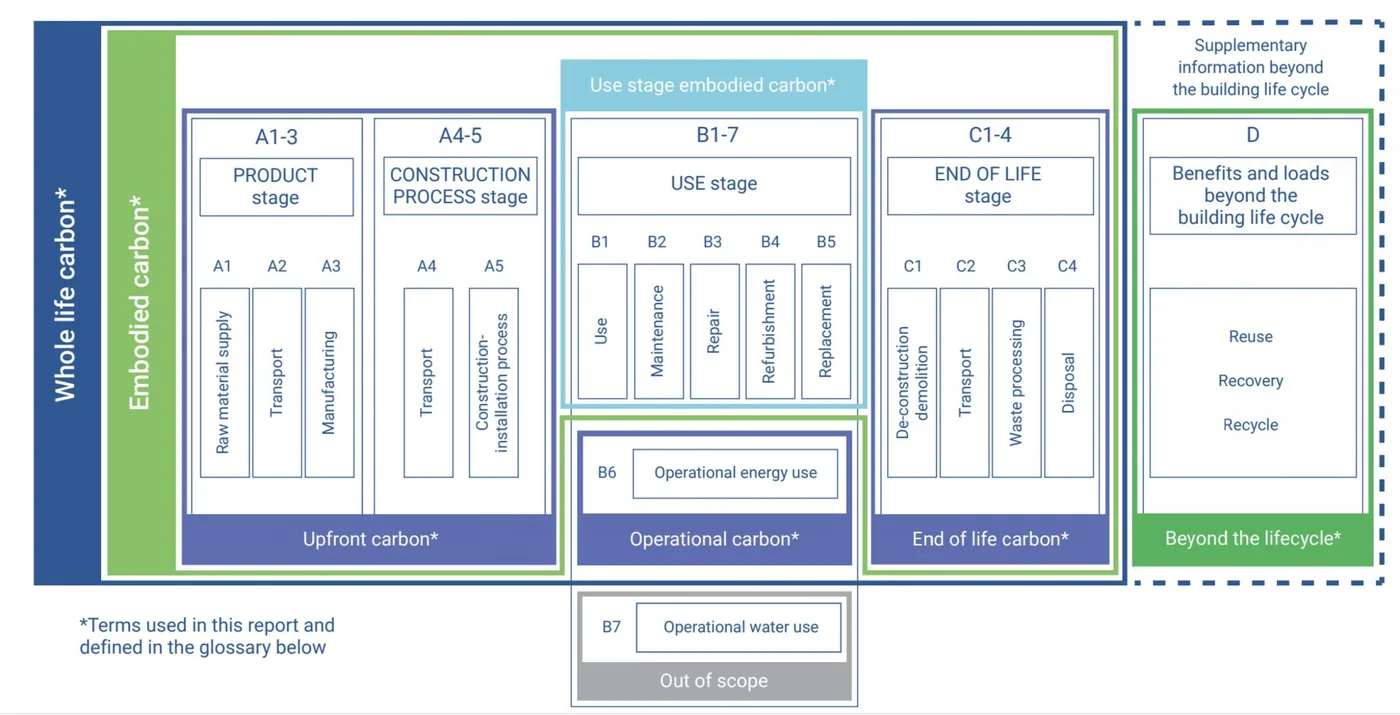
In the following, this article is based on the boundaries described in Figure 1. Besides embodied carbon, there are also embodied energy and embodied emissions, which are not discussed in more detail here.
2. What is a PCF?
The Product Carbon Footprint (PCF) is a standardised method for quantifying the greenhouse gas emissions of a product across its entire life cycle. It usually starts with raw material extraction and – depending on the chosen system boundary – extends to use, disposal or potential recycling. The results are expressed in CO2 equivalents (CO₂e) and provide a reliable data basis for analysing emission sources in the value chain.
The PCF enables companies to identify reduction potential in a targeted way, optimise processes and create transparency towards customers, partners and regulators.
Create transparency – calculate PCFs professionallyDepending on the chosen system boundary of a Product Carbon Footprint (PCF), different life cycle phases and therefore different amounts of greenhouse gas (GHG) emissions are captured.
As a rule: the wider the system boundary, the more comprehensive the emissions balance. The cradle-to-cradle approach is the most far-reaching variant, as it also fully accounts for recycling.
The following figure gives an overview of the common system boundaries:
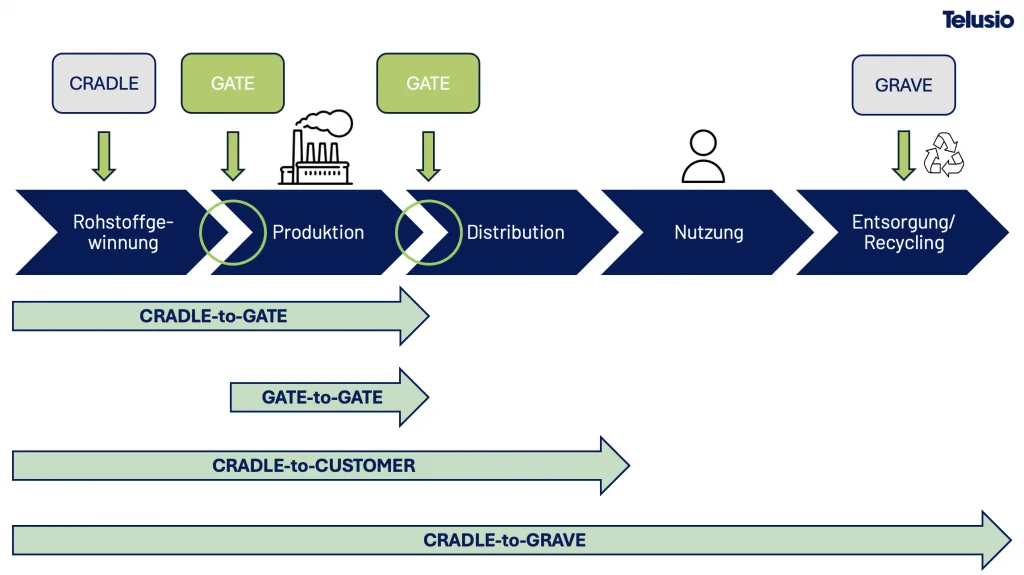
The chosen system boundary determines which life cycle phases are considered – and thus how comprehensive a product’s carbon footprint is. To ensure comparability and methodological consistency, companies rely on established standards:
- ISO 14067 – carbon footprint of products
- GHG Protocol – Product Life Cycle Accounting and Reporting Standard
These frameworks define binding rules for data sources, documentation and calculation methods. Applying them enables not only compliance with regulatory requirements but also transparent communication with customers, partners and investors.
3. Embodied carbon vs. PCF – what is the difference?
In the carbon accounting of products and buildings, two concepts have become established that come from different contexts but pursue a common goal: systematically capturing and reducing greenhouse gas emissions across the life cycle.
According to the World Green Building Council (WGBC), embodied carbon refers to all greenhouse gas emissions arising in the life cycle of a product or building – excluding the energy-related emissions during the use phase (operational carbon). The methodology follows a cradle-to-grave approach, with the energy-related shares of the operational phase explicitly excluded (see Figure 1).
For buildings and infrastructure in particular, this approach is a practical assessment method, as it captures the climate-relevant emissions that occur before and after use – for example from material extraction, manufacturing, transport, maintenance or disposal. Because of its closeness to industry-specific standards and established assessment schemes, the approach is mainly used in construction. It provides a structured basis for quantifying so-called grey emissions and supports targeted decarbonisation in planning and construction processes.
The Product Carbon Footprint (PCF) is an established instrument for capturing greenhouse gas emissions across the entire life cycle of a product. Because of its level of detail at product and component level, the method is particularly suited to manufacturing industries, where emissions need to be allocated precisely along complex supply chains.
The term PCF developed from the general concept of the “carbon footprint”, which was increasingly used in the early 2000s to assess emissions at household and company level. By contrast, the term embodied carbon originally comes from construction in the English-speaking world, where it was used to assess the climate impact of building materials and buildings. Today, however, the concept is also applied across industries – especially to quantify and reduce so-called grey emissions, i.e. those that arise in upstream processes before a product is actually used.
What are “grey emissions”?Grey emissions (also called grey greenhouse gas emissions) are indirect CO2 emissions that arise during the manufacture, processing, transport, storage and disposal of products and materials – i.e. before or after a product is used. They are “grey” because they are not directly visible, unlike the CO2 emitted when heating or driving a car.
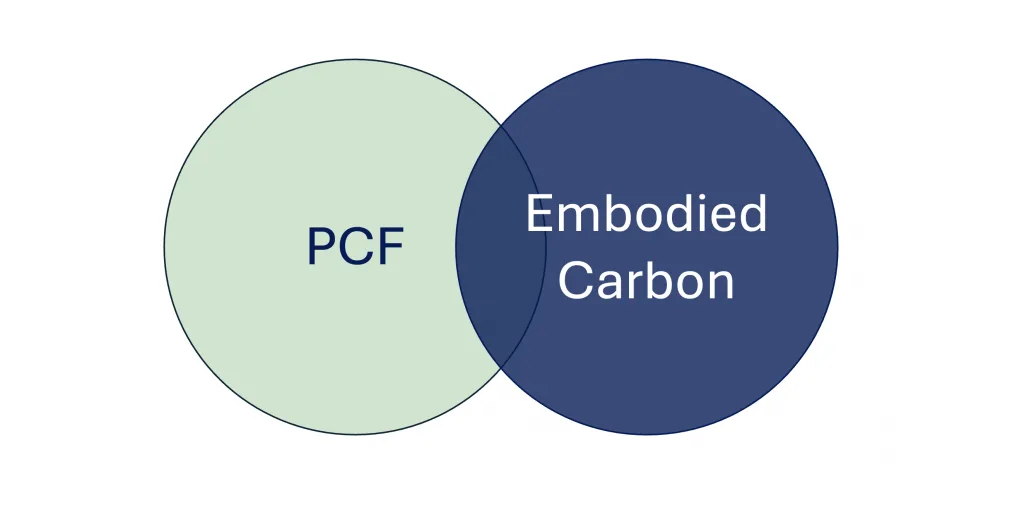
Both concepts play a central role in carbon accounting. They differ in their system boundary and objective, but complement each other in practice: the PCF provides a (complete) carbon footprint at product level, while embodied carbon is used particularly where the focus is on buildings, infrastructure or upstream supply chains.
Here is an overview:
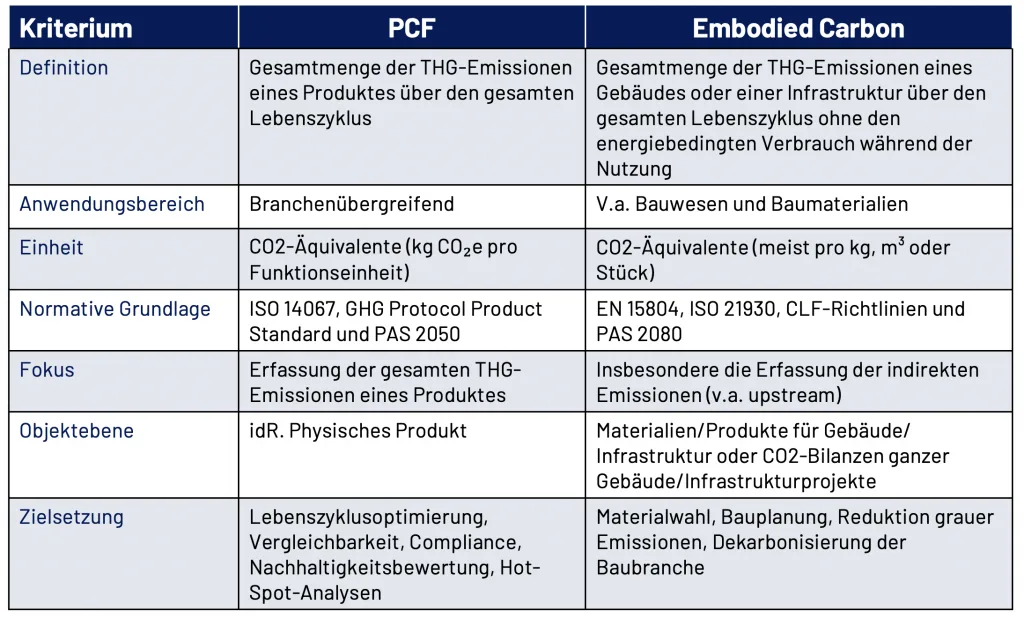
Is there actually a difference between PCF and embodied carbon?
There is no blanket answer to this question, as the two concepts are based on different system boundaries and perspectives. What is clear, however: a direct comparison of the results is not readily permissible, as both the underlying system boundaries and the content of the calculation sometimes differ considerably.
An example from construction practice illustrates this:If the carbon footprint of one tonne of structural steel is calculated once as a PCF (with the LCA boundary “cradle-to-gate”) and once as embodied carbon (based on “upfront carbon”), there are methodological differences.
While the PCF emissions end when the steel leaves the steelworks, embodied carbon additionally includes transport emissions to the construction site and emissions during installation. As a result, the system boundary of embodied carbon extends further than that of the PCF.
To make both values comparable, either additional emissions would have to be added to the PCF or certain shares removed from the embodied carbon. In addition, the functional unit would have to be aligned (e.g. CO2 equivalents (CO₂e) per kg of material).
As a rule: the wider the system boundary, the more complex the calculation. It is crucial to understand that PCF and embodied carbon do not measure the same thing, but both work towards the same goal – transparency and the reduction of greenhouse gas emissions. A direct comparison is therefore only possible with methodological care, but can be useful in detailed sustainability reports.
4. How are PCF, embodied carbon and Scope 3 related?
The division into Scope 1, 2 and 3 emissions is based on the GHG Protocol Corporate Standard. Scope 3 describes all indirect emissions along the value chain that arise upstream or downstream of a company’s own operations – for example from purchased materials, transport, use or disposal. Here is another overview of how the scopes of the GHG Protocol apply within the LCA system boundaries:
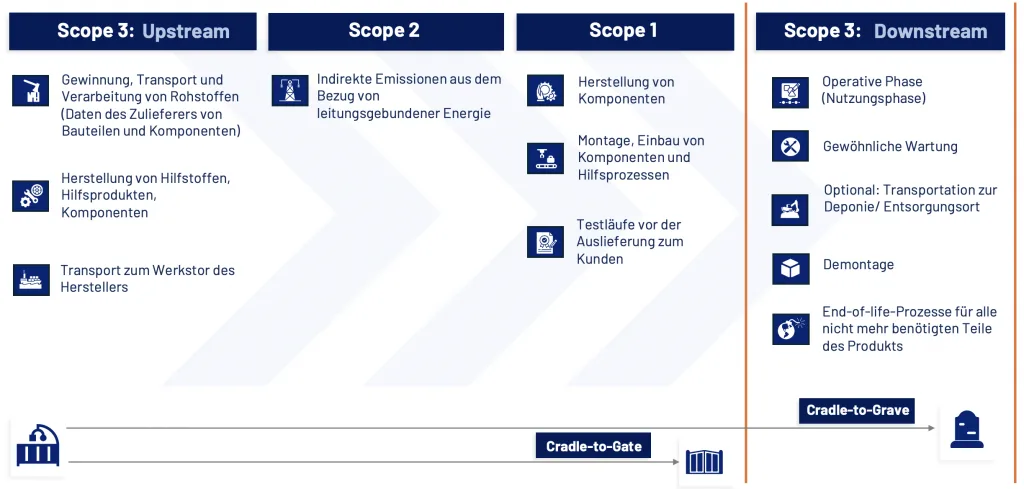
These Scope 3 emissions in particular are increasingly the focus of sustainability reports, as in many industries they account for the largest share of total emissions. Accordingly, it is important to take them into account when defining system boundaries – for example when calculating a PCF or embodied carbon.
In practice, for PCFs – especially in machinery and plant engineering – often more than 90% of CO2 emissions come from purchased intermediate products and services. These emissions lie entirely upstream.
A similar pattern emerges when accounting for building-related emissions: a large share of emissions arises before actual use, for example from energy-intensive building material production, raw material extraction or transport to the construction site with emission-intensive vehicles. These upstream processes are therefore among the central drivers of the carbon footprint of buildings and should be systematically considered in comprehensive climate strategies.
According to the GHG Protocol, Scope 3 emissions include all indirect GHG emissions that arise outside a company’s direct control. These include both upstream and downstream activities along the value chain – such as the manufacture of purchased goods, transport by third parties, use by end customers or disposal processes. Unlike Scope 1 (direct emissions) and Scope 2 (indirect emissions from purchased energy), Scope 3 categories are methodologically more complex to capture, but form an essential part of the overall balance.
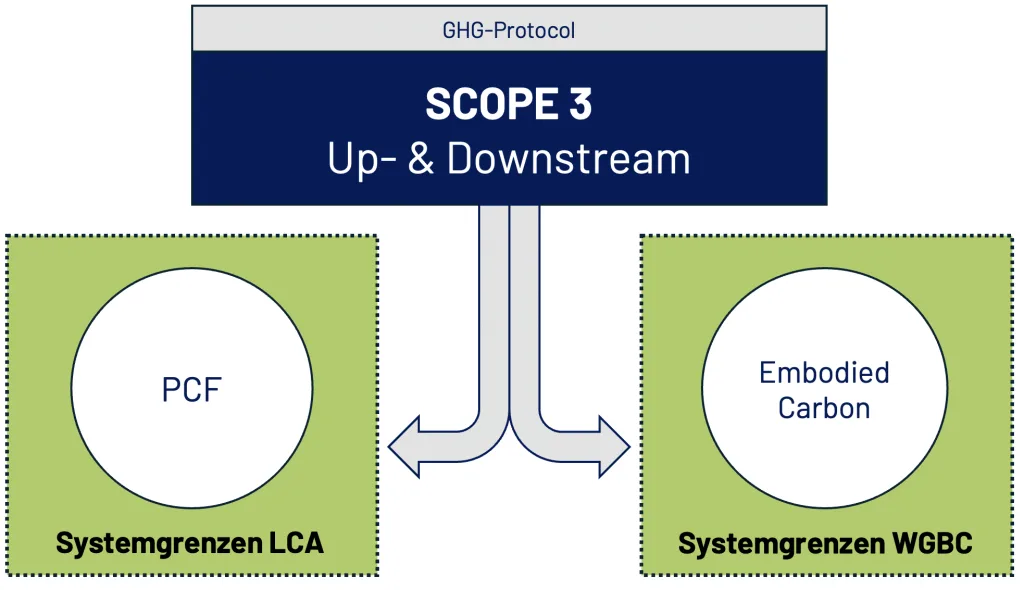
The distinction from PCF and building-related emission calculations results from their respective objectives: while Scope 3 targets the company-wide GHG balance, PCF and embodied carbon serve the quantitative assessment at product or asset level. There is overlap in content especially upstream – for example with emission-intensive materials or logistics services that are relevant in both systems.
A sound recording and assessment of greenhouse gas emissions therefore requires an understanding of the different methodological approaches. Combining the organisational perspective (Scope 3) and the product perspective (PCF, embodied carbon) enables a differentiated analysis of emission sources and supports the development of effective decarbonisation strategies.
Telusio’s view: two perspectives, one goal
Credible sustainability strategies need reliable emission data – and suitable methods to capture it in a structured way. The Product Carbon Footprint (PCF) and embodied carbon are two proven approaches to capturing CO2 emissions with different focuses: the PCF is particularly suitable for products, while embodied carbon is often used for buildings or infrastructure.
The methodological differences allow a tailored approach: depending on the industry, data situation or objective, both concepts can be used separately or together. This way, emissions are captured specifically where they matter most – for example in product design, in the supply chain or in investments. Neither method is “better” per se – both provide a sound basis for decisions on effective climate protection. In future, embodied carbon could also provide valuable impetus in other industries.
Both approaches pursue the same goal: reducing CO2 measurably and effectively. They offer different but complementary perspectives. What matters is not which approach is “more correct” – but that accounting happens at all. Those who know and use the right tools turn climate targets into concrete action.


Your customer is asking for a PCF?Let’s talk.
Discover the easiest way to audit-ready PCFs – AI-powered and expert-reviewed.
Book an initial call