
Blog
Insights from PCF practice
Studies, analyses and experience from projects with industrial companies.Articles are currently available in German only.
December 13, 2024 · 8 min read · Dr. Johannes Weibl
Two Paths to the PCF: Activity-Based and Spend-Based Compared
Articles are currently available in German only.
Whether due to regulatory requirements such as the CSRD, customer requirements, an SBTi commitment or their own strategic interest – more and more companies face the task of calculating the CO2 emissions of their products precisely.
The Product Carbon Footprint (PCF) is becoming the central management tool: it creates transparency about emission sources, allows products to be compared and is the basis for credible reduction measures.
But how do you achieve a reliable calculation – especially with complex supply chains or missing primary data?
When quantifying emissions, there are basically two approaches: spend-based and activity-based. But which method is best suited for the calculation? This overview looks at the two most common methods and shows how companies can assess the emissions of their products precisely and practically in order to make sound, forward-looking decisions.
What is carbon accounting?

Carbon accounting, also known as CO2 accounting or carbon footprinting, is the systematic method of recording, calculating, assessing and monitoring greenhouse gas (GHG) emissions generated within a process.
Carbon accounting can be applied both to entire companies (CCF) and to individual activities or products (PCF) and provides a snapshot of the emissions generated by a process, usually updated annually.
For more information on this topic, click here.
What is primary data and what role does it play in PCFs?
Primary data as a collection method: advantages and challenges
Strictly speaking, primary data is not a calculation method but a collection method.
It captures the actually measured values of activities and processes along the entire value chain. As it can reflect real emissions precisely – provided the measurement is correct – it should always be preferred. However, collecting it is extremely demanding and time-consuming. The effort involved in collecting primary data alone should not be underestimated, as it requires extensive expertise, considerable human resources and substantial funds. Depending on the process, specialised tools are required to carry out the measurements. In addition, data must be recorded regularly, sometimes even daily, to obtain meaningful annual averages. In more complex processes, special analysis tools are often indispensable to make data processing possible at all.
Calculating the Product Carbon Footprint on the basis of primary data is the theoretical ideal, but can hardly be implemented completely in practice. Especially for Scope 3 emissions, companies depend on third parties providing data. As most suppliers can provide either no primary data or only incomplete data, a calculation based exclusively on primary data is usually not feasible.
Practical alternatives: activity-based and spend-based methods
That is why there are activity-based and spend-based quantification methods, which make it possible to carry out a PCF calculation even when primary data is missing or incomplete. These methods offer a practical solution to complete primary data collection, which is often not feasible in practice. Both approaches help companies produce a sound and reliable carbon footprint of their products.
What methods are there for quantifying the CO2e emissions of a product?
The best-known methods for carbon accounting are the spend-based and the activity-based method. There are also many hybrid models that combine the approaches of the different methods.
1. Spend-based method
The so-called spend-based emission factor is a representative value that relates the amount of an emission to a certain monetary expenditure. This makes it possible to calculate the amount of emissions generated per financial unit of a certain activity. It is assumed that financial or accounting transactions have an indirect relationship to emission-related physical activities and can therefore serve as a basis for calculating emissions. One example of an indirect emission flow is paying an energy bill, as the emissions are caused by energy generation and not directly by the company itself.
The spend-based method calculates the emissions of a monetary amount as follows:
Monetary amount x emission factor of the good or service =
total kg CO2e
With the spend-based method, the decisive factor would be the purchase price of €650 for one tonne of reinforcing steel, while the activity-based method uses the quantity of one tonne of reinforcing steel as the key figure for calculating emissions. This clearly shows the difference between a spend-based and an activity-based emission factor: spend-based considers purely monetary flows, while activity-based looks at the flow of activities (goods, services, etc.).
2. Activity-based method
With the so-called activity-based emission factor, GHG emissions are calculated on the basis of the respective activities or processes. As this approach is extremely detailed, most activities along the entire value chain must be recorded. Activities include, for example, the individual raw materials purchased or the electricity consumed in production. The raw data is then multiplied by suitable emission factors. As this method delivers accurate emission values based on actual activities, it should be chosen when GHG emissions are to be captured as realistically as possible.
The activity-based method calculates the emissions of an activity as follows:
Activity in unit 1 (e.g. kg, kWh, etc.) x emission factor =
total kg CO2e
Quantifying emissions: spend-based vs. activity-based
The spend-based and activity-based methods for quantifying greenhouse gas emissions offer different approaches, each with advantages and disadvantages, especially in terms of cost, time, required expertise, strategic benefit, applicability of results and precision:
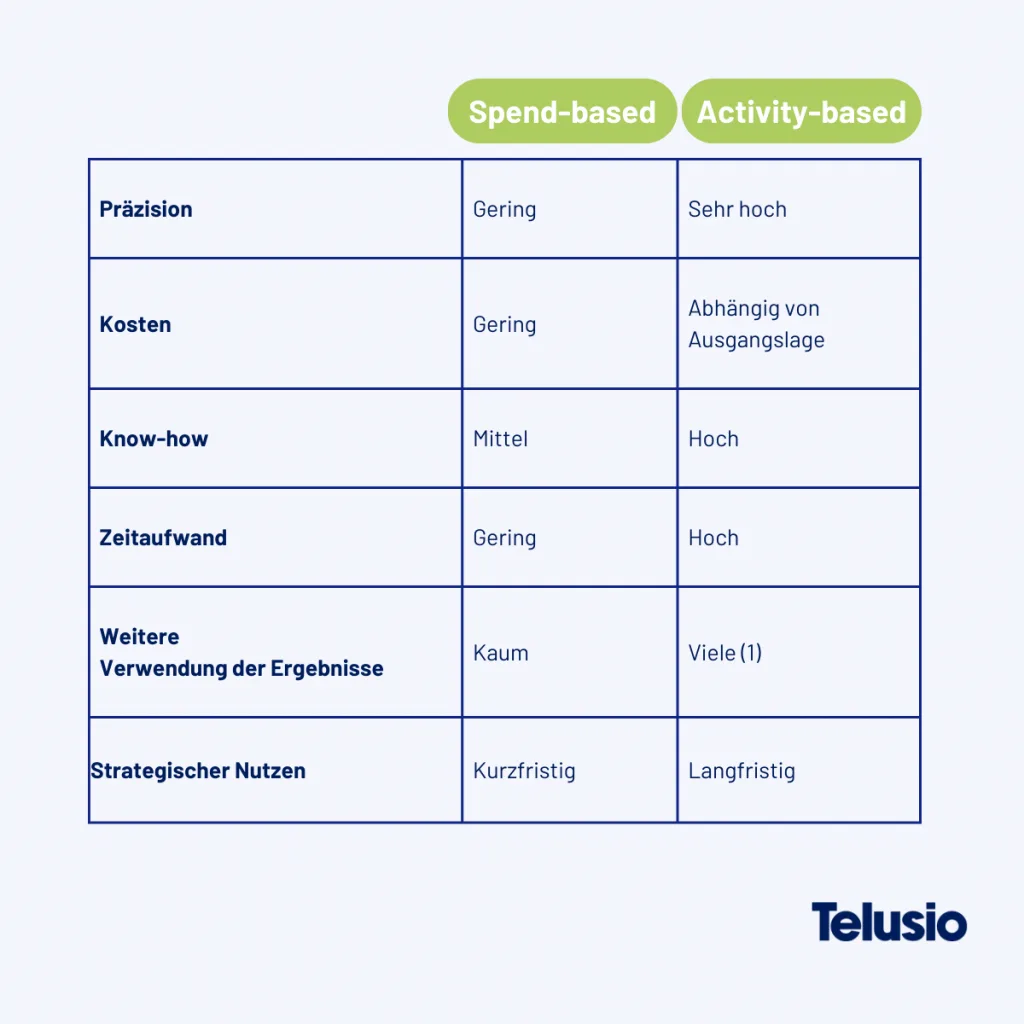
(1): The activity-based method enables a detailed recording of emission data that can be used in many ways. Once an activity has been assigned an emission factor, this saves considerable time and effort in later steps. The same data can easily be used to create a Corporate Carbon Footprint (CCF) and, if required, transferred to a Product Carbon Footprint (PCF) or other standards. This is in contrast to the spend-based method, whose applicability is much more limited.
Spend-based method: quick and inexpensive estimation of emissions
This approach requires little expertise, as the method is based on easily accessible financial data and does not require in-depth technical analysis of processes. In companies recording their emissions for the first time, the spend-based method can therefore serve as a practical starting point and provides a quick overview of approximate CO₂ emissions.
The spend-based method enables a quick and inexpensive estimate of emissions by using financial expenditure as a basis and multiplying it by emission factors for certain spending categories (e.g. transport or energy).
Limits of the spend-based method and the need for a more precise alternative
However, the method has clear limits in precision: as it is based only on the company’s expenditure and does not use individual activity data (such as details on materials, processes, etc.), it cannot make an exact statement about specific emission sources. Cost fluctuations due to inflation or other market changes have a direct effect on the calculation and can distort the results. Price inflation would accordingly mean an automatic increase in the emissions caused.
The spend-based method provides basic orientation, but is neither sufficient for developing long-term reduction strategies nor for meeting precise legal requirements. Its limited applicability, for example under the CSRD or in achieving SBTi targets, makes it hardly advisable in the long term. In view of continuously tightening non-financial disclosure obligations, it should be replaced by the more precise activity-based method in the long term. A comprehensive cost-benefit analysis is indispensable in this context, as dependence on the spend-based method could prove uneconomical.
Activity-based method: precise emission calculation and targeted reduction measures
The activity-based method, on the other hand, offers the accuracy needed for reliable and future-oriented emission calculation. It is based on directly recording emission-relevant activities in the company, such as the energy consumption of individual machines, transport kilometres or the quantities of certain raw materials. Because concrete process data is used, emission sources can be precisely located and analysed. This enables targeted and effective reduction measures that are strategically valuable, as they reduce the carbon footprint at both company and product level in the right places, helping the company meet strategic commitments such as SBTs.
The activity-based method can also be applied flexibly and repeatedly: activity data, once determined, can be used in numerous contexts, for example for optimising the emissions of individual departments or for reporting to stakeholders. This approach is also indispensable for companies that want to establish detailed carbon accounting in the long term and must meet legal requirements. Another advantage of the activity-based method is its independence from price developments: inflation fluctuations or market-related price changes have no influence, as the calculation is based on physical activities.
Long-term efficiency and strategic relevance of the activity-based method
Although introducing the activity-based method initially requires more effort, the resources needed for subsequent calculations decrease considerably. Thanks to the steep learning curve, companies can apply the activity-based method more efficiently with growing routine and minimise resource requirements in the long term. It offers a future-proof basis that ensures reliable and comprehensive documentation even as regulatory requirements increase. In a market environment that increasingly values transparency and detailed sustainability reports, the activity-based method is therefore becoming the more reliable long-term choice for companies.
Conclusion: choosing the right method for quantifying emissions
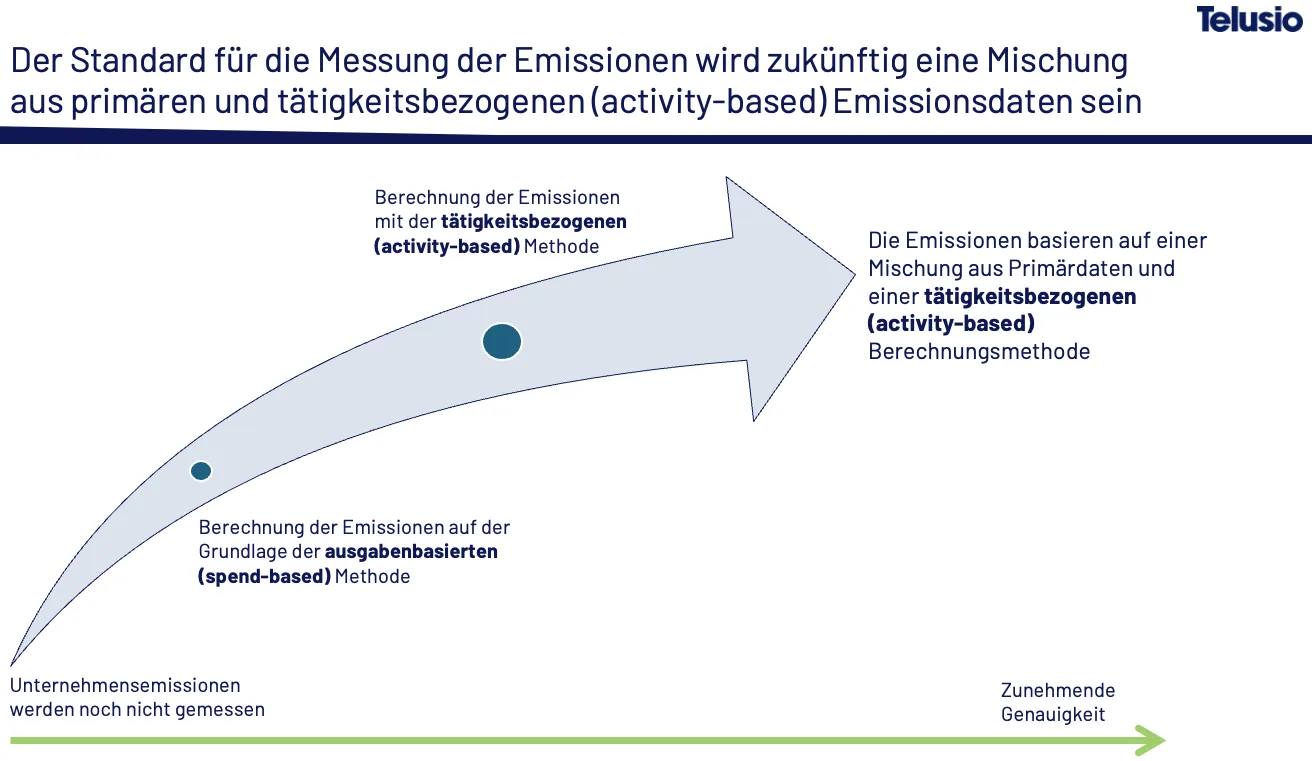
In summary: while the spend-based method offers a simple and quick overview, the activity-based method requires more resources but delivers the precision and reliability needed to make emissions accounting sustainable and meet growing legal requirements.
The choice of the right method for quantifying greenhouse gas emissions depends largely on the company’s individual goals and requirements. The spend-based method can serve as a first rough approach for basic orientation. In the long term, however, it is neither sufficient nor resilient to external factors such as financial fluctuations.
In contrast, the activity-based method offers decisive advantages: it enables the detailed recording of individual activities and processes and precisely uncovers emission sources that often remain inaccurate or are overlooked in other approaches. The activity-based method thus provides the basis for targeted, effective emission reduction measures and long-term optimisation of the entire value chain.
Telusio’s view
Primary data is the “gold standard” among emission calculations, but recording and measuring it correctly is only the first step; passing it on to external parties without errors is just as crucial. This process involves considerable sources of error and presents companies with major technical challenges that must first be overcome. Until its collection becomes standard or at least more common, the activity-based method should serve as a reliable basis. Companies can start with the activity-based method and gradually supplement it with primary data as it becomes available. For companies that approach sustainability strategically and need exact data for active emissions management, the extra effort of the activity-based method is a worthwhile investment in a credible and forward-looking sustainability strategy.

Your customer is asking for a PCF?Let’s talk.
Discover the easiest way to audit-ready PCFs – AI-powered and expert-reviewed.
Book an initial call