
Blog
Insights from PCF practice
Studies, analyses and experience from projects with industrial companies.Articles are currently available in German only.
December 4, 2024 · 3 min read · Dr. Johannes Weibl
The Battery Passport in the Context of European Regulation

Articles are currently available in German only.
Standards for a sustainable future: standards for environmental accounting and innovation
With growing demand for electric vehicles and energy storage solutions, the battery industry is increasingly at the centre of the sustainability debate.

The battery passport, a central EU initiative, is intended to enable transparency and comparability along the entire life cycle of a battery and is part of the European strategy to promote a sustainable and responsible battery industry.
The carbon footprint is one of the key metrics recorded in the battery passport and reported according to international standards in order to document the environmental impact of batteries as comprehensively and precisely as possible.
The battery passport and the prominent role of carbon accounting

The battery passport is a set of rules that defines the requirements for documenting and disclosing environmental impacts along the battery supply chain.
The carbon footprint plays an outstanding role.
Calculating the carbon footprint in particular is firmly anchored, as it is intended to make the climate impact of batteries transparent and measurable. To document this carbon footprint reliably and comparably at international level, the battery passport relies on specific standards and methodologies.
The framework for this is provided by the Product Environmental Footprint (PEF), which can also be used for other environmental impacts. The PEF assesses the environmental performance of a product across all relevant life cycle phases. The product-specific Product Environmental Footprint Category Rules (PEFCRs) prescribe exactly how these dimensions are to be calculated for certain product categories, ensuring a consistent and comparable methodology.
The PEFCRs for batteries are thus a specific guide that ensures the calculation of environmental impacts, especially the carbon footprint of batteries, is carried out in line with EU requirements.
PEFCRs are to be seen as product-category-specific collections of the rules for calculating all relevant environmental impacts. They are therefore based on existing, established rules and specify them where necessary. In the case of the carbon footprint, the calculation is based on the already established EN ISO 14067.
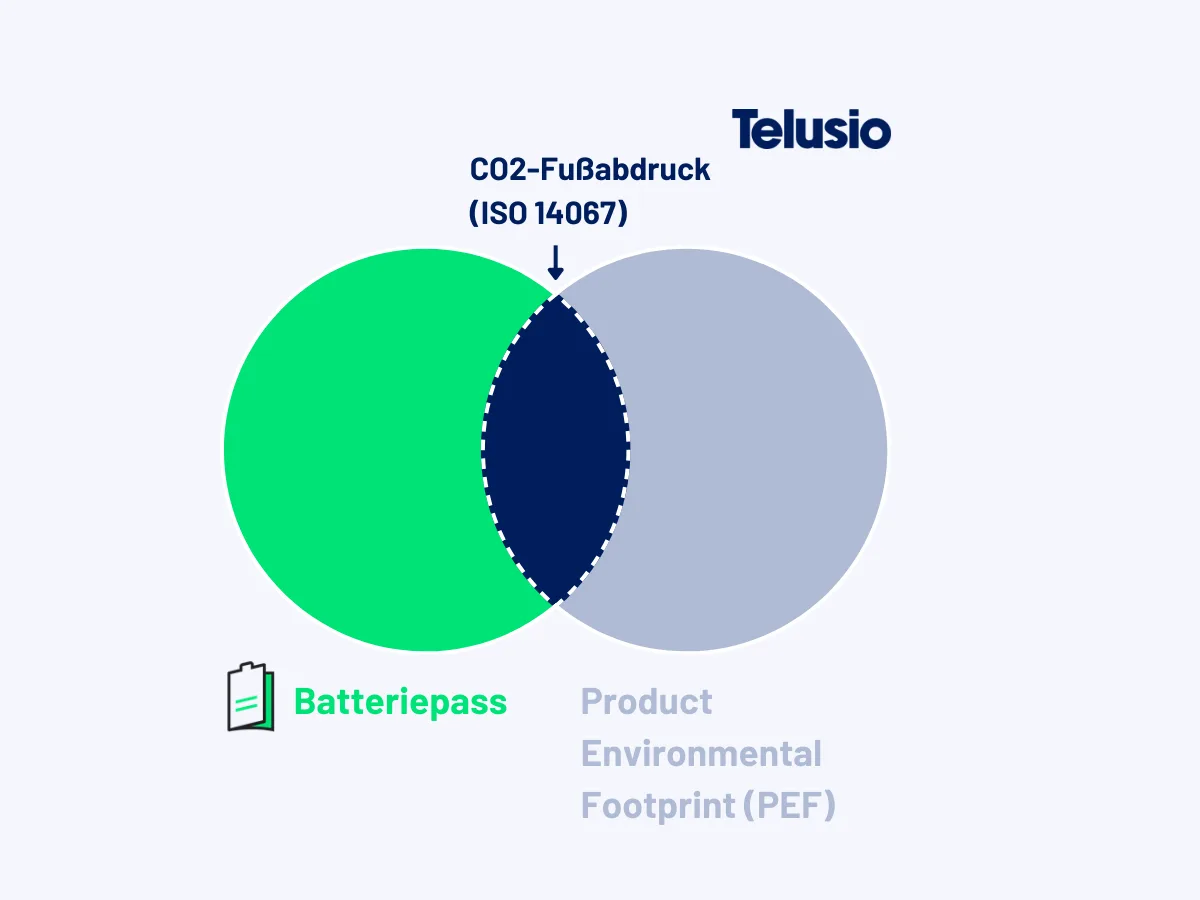
The carbon footprint as the interface between the requirements of the PEF and the battery passport.
Can these requirements still change?
In principle, the entire framework of the battery passport is still being refined by the EU, and we are currently in a transition phase. This will help the EU collect initial data and adapt the new regulations accordingly. It is planned that the calculation requirements for the battery passport will be specified further in the form of additional PEFCRs from 2026. The requirements for the carbon calculation could then be adapted to progress in the PEF methodology in order to integrate current scientific findings and technological developments into reporting. However, the calculation of the carbon footprint is not expected to change significantly, as a link to ISO 14067 and ISO 14044/40 is essential for international comparability and standardisation.
In addition, minimum requirements for the carbon footprint have yet to be established, which could also become mandatory from 2026.
Telusio’s view
The battery passport will be a central instrument for promoting transparency and sustainability in the battery value chain. By integrating PEF, PEFCR and ISO 14067, it creates a standardised basis for measuring and reporting the environmental impacts of batteries. Calculating the carbon footprint according to these standards will help companies record their emissions in every life cycle phase and initiate targeted reduction measures.




Your customer is asking for a PCF?Let’s talk.
Discover the easiest way to audit-ready PCFs – AI-powered and expert-reviewed.
Book an initial call