
Blog
Insights from PCF practice
Studies, analyses and experience from projects with industrial companies.Articles are currently available in German only.
December 4, 2024 · 6 min read · Dr. Johannes Weibl
Relevant Standards for Sustainable Accounting of Environmental Impacts
Articles are currently available in German only.
An article from our series
Standards for a sustainable future: standards for sustainability and innovation
In view of the climate crisis and the associated EU requirements, the need to systematically record and reduce greenhouse gas emissions has become a central goal for companies.
This has decisively driven the development of standards for calculating and reporting the environmental impacts of individual companies and products. A distinction is made between standards at company level, which capture the emissions of the entire company, and product-related standards, which cover the environmental impacts of individual products. Greenhouse gas emissions in particular are a central environmental impact that has come into focus.
This article provides an overview of the most important standards in the context of environmental impacts at product level, explains the role of the key organisations and the individual standards, as well as the PEF standards developed specifically for Europe and their practical application in environmental product declarations (EPDs).
Background: where new norms and standards come from – standardisation organisations
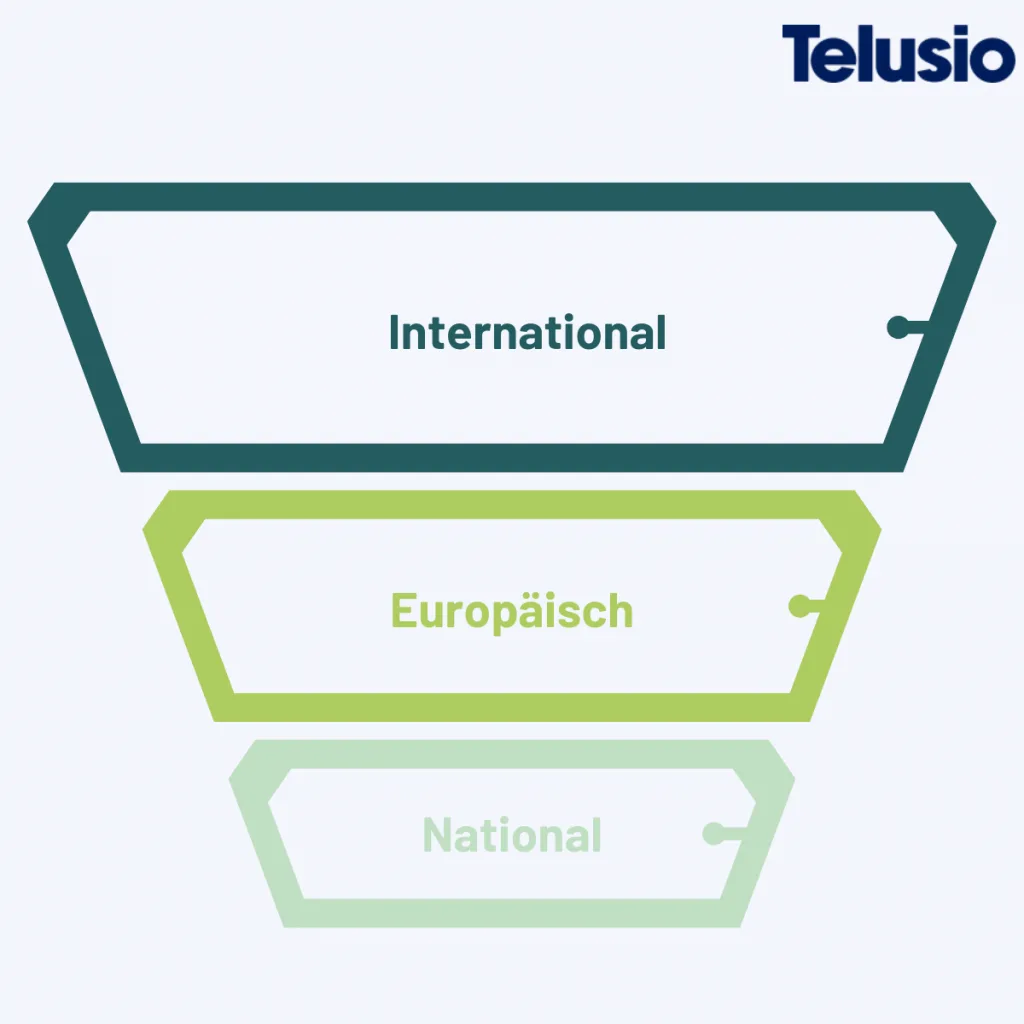
At global level, the International Organization for Standardization (ISO) is centrally responsible for developing globally valid standards in a wide range of areas, including environmental management and climate protection. Its standards are used in numerous industries and provide a uniform basis for carbon accounting and life cycle assessments. ISO is complemented by European standardisation organisations such as CEN and CENELEC, which often convert ISO standards into European standards (EN) to take regional requirements and legislation into account.
Finally, at national level, institutes such as the German Institute for Standardization (DIN) implement international standards in national contexts and ensure adaptation to national circumstances.
A detailed overview of the standardisation organisations can be found here in our insights article.
Product-level standards: EPD vs. PEF
Product-level standards: from life cycle assessment to the carbon footprint standard
A central starting point for accounting for a product’s environmental impacts is life cycle assessment (LCA), set out in the ISO standards ISO 14040 and ISO 14044.
These international standards define the methodological framework for a comprehensive assessment of a product’s environmental impacts across its entire life cycle.
Building on this, there is another important standard to consider: ISO 14025. It is an international standard that sets out principles and procedures for type III environmental labels and declarations, also known as Environmental Product Declarations (EPDs).
For specific product categories, there are Product Category Rules (PCRs), which are based on ISO 14025. PCRs set out specific requirements for accounting for and reporting environmental impacts for certain product categories. They comprise a set of specific rules or guidelines for a product category and can vary in methodology and scope, as they are often developed by different organisations or industry associations. The scope of PCRs can be very different, ranging from specific products (such as aluminium window frames) to entire product classes (such as chemical products).
The environmental impacts calculated according to the PCRs are disclosed in an Environmental Product Declaration (EPD), as defined in ISO 14025. EPDs cover aspects such as carbon footprint, energy consumption and resource use and enable a clear, traceable and comparable presentation of environmental impacts. An EPD is thus a central part of environmental communication at product level and uses standardised data to create a clear, traceable and comparable presentation of environmental impacts. Accordingly, new PCRs are often published by EPD programme operators.
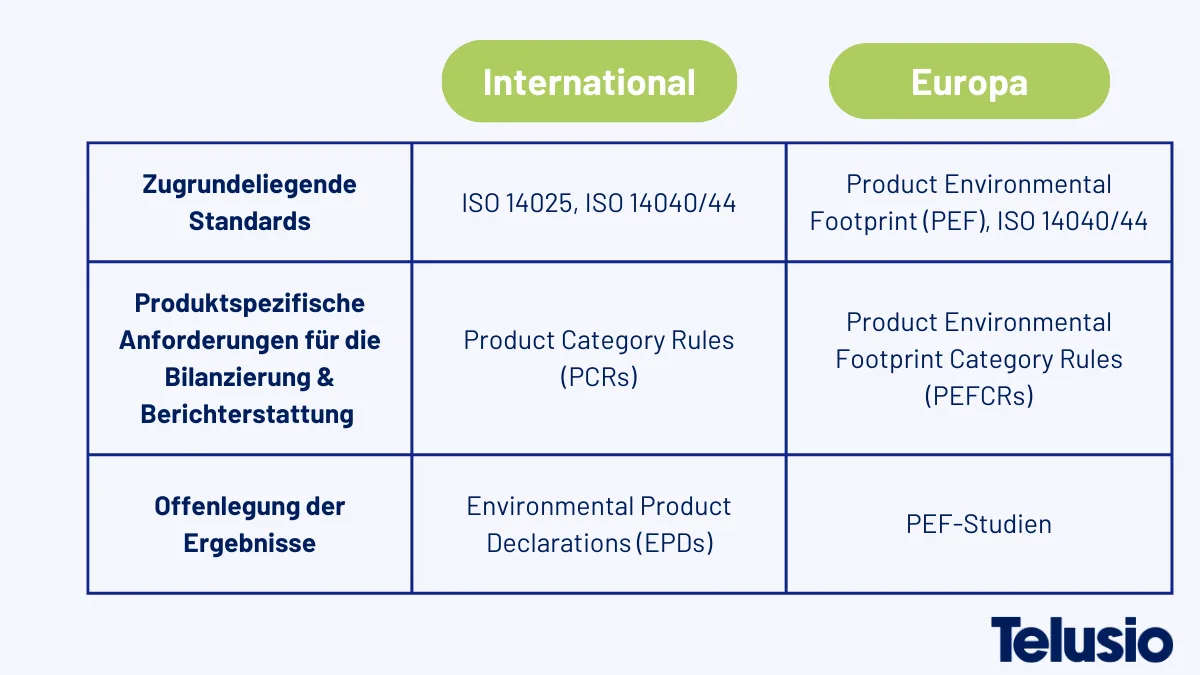
Overview of the international and European framework for calculating the environmental impacts of individual products.
Product-level standards: from life cycle assessment to the carbon footprint standard
The European Commission introduced the Product Environmental Footprint (PEF) as a further development of the ISO standards for life cycle assessment (ISO 14040/44).
The PEF offers a comprehensive approach to assessing the environmental impacts of products that, in addition to the carbon footprint, also considers aspects such as water consumption and resource use. Although the PEF method is not fully ISO-compliant, it standardises the environmental assessment of products within Europe.
For specific product categories, the Product Environmental Footprint Category Rules (PEFCRs) were developed as part of the PEF initiative. They are the counterpart to Product Category Rules (PCRs) and serve as the basis for conducting PEF studies. A PEF study determines the environmental footprint of a specific product across its entire life cycle, based on the requirements of the corresponding PEFCRs. A PEF study is therefore the PEF counterpart to an EPD.
PEFCRs are developed in collaboration with market leaders and LCA experts and aim to improve the reproducibility, relevance and consistency of PEF studies.
Although the European Commission is still working out the details of the PEF, companies can already develop PEFCRs using these guidelines. When developing a new PEFCR, existing PCRs are searched for first. Suitable PCRs can serve as a basis and be adapted accordingly.
So what is the difference between PCRs and PEFCRs?
PCRs are based on ISO 14025 and are often developed by various international organisations or industry associations, which can lead to variations in methodology and scope. PEFCRs, on the other hand, are part of the European Commission’s PEF initiative and aim for a more harmonised and comprehensive approach in the EU context.
While PCRs serve as the basis for environmental product declarations (EPDs), PEFCRs are specifically geared towards conducting PEF studies.
PEFCRs aim for greater comparability and consistency between products of the same category by specifying detailed rules for calculating the environmental footprint. Overall, PEFCRs offer a more standardised framework for environmental assessments, while PCRs can respond more flexibly to specific industry needs.
Focus on carbon accounting: the Greenhouse Gas Protocol and ISO 14067
The carbon footprint is a central aspect in assessing the environmental impacts of a product. As a widespread and standardised metric, calculating greenhouse gas emissions across the entire life cycle of a product is based on established standards.
Greenhouse gas emissions can be recorded at both product and company level. The Greenhouse Gas Protocol (GHG Protocol) is an important standard here. It offers comprehensive guidelines for accounting for emissions in different scopes, based on a company’s influence on the emission sources. The GHG Protocol serves as the basis for other standards, including the ISO standard 14067.
ISO 14067 focuses specifically on the carbon footprint of products (PCF) and defines the methodology for calculating CO₂ emissions along the product life cycle. This standard builds on the LCA standards (ISO 14040 and ISO 14044) and enables detailed recording of carbon emissions as part of comprehensive environmental accounting.
Telusio’s view
The variety and complexity of norms and standards in carbon accounting and environmental accounting reflect the growing importance of these topics in the global economy. While international standards such as the ISO standards enable worldwide comparability, European initiatives such as the Product Environmental Footprint (PEF) offer more specific and comprehensive approaches for the EU market.
For companies, this is a challenge on the one hand, as they have to deal with different sets of rules. On the other hand, these standards also offer opportunities: they provide a structured and recognised method for recording and communicating environmental impacts, which benefits both internal improvement processes and external communication with stakeholders.
The continuous development of these standards, especially with regard to harmonising international and European approaches, will be crucial for the future of sustainable business. Companies that familiarise themselves with these standards early and integrate them into their business processes will be better positioned to meet future regulatory requirements and strengthen their competitiveness in an increasingly environmentally conscious market.

Your customer is asking for a PCF?Let’s talk.
Discover the easiest way to audit-ready PCFs – AI-powered and expert-reviewed.
Book an initial call