
Blog
Insights from PCF practice
Studies, analyses and experience from projects with industrial companies.Articles are currently available in German only.

Articles are currently available in German only.
Climate neutrality has long ceased to be an optional goal – it is a necessity. Companies that do not record and reduce their CO2 emissions precisely risk losing customers, violating regulatory requirements and weakening their competitiveness.
While many companies focus on decarbonising physical products, one crucial area is often overlooked: services.
They too cause significant emissions that need to be measured, assessed and optimised. But why is this so complex – and what pitfalls lie in wait?
What is the Service Carbon Footprint?
The Service Carbon Footprint (SCF) describes the amount of CO2 emissions generated by providing a service, such as transporting goods or sending a text message.
Even though services are not tangible like products, they have a considerable influence on a company’s carbon footprint. This footprint is generated by various factors: the energy consumption of data centres, employee travel, the use of office supplies or the use of IT infrastructure. Even if services seem immaterial at first glance, providing them causes numerous emissions.
While services may seem climate-neutral at first glance, they often consist of many different dimensions. And all of these dimensions can, depending on the context, contribute emission-relevant activities.
The complexity of carbon accounting in the service sector
Calculating the Service Carbon Footprint is a complex task. The reason lies in the multitude of aspects that have to be considered to reach a precise and reliable result. Knowledge of the relevant emission sources and the correct application of standards such as ISO 14067 is crucial.
ISO 14067 provides a detailed method for calculating the carbon footprint and ensures that companies take into account not only direct energy consumption but also indirect emissions such as those caused by suppliers or third parties. But referring to one ISO standard is not enough. Depending on the context, other standards may also be relevant for calculating the emissions of services.
One example is ISO 14083 in the logistics sector. It sets specific requirements for calculating emissions in transport and logistics. Especially for services based on mobility or IT infrastructure, these standards are essential to enable standardised calculation.
Once the relevant standards have been identified, nothing should stand in the way of calculating the emissions – right?
The challenge of system boundaries
But the devil is in the detail: it is not always clear which aspects of a service are emission-relevant and which are not. A crucial point in the carbon accounting of services is defining the system boundaries.
Without sound expertise and the precise application of ISO 14067 and other standards such as ISO 14083, companies can easily fall into the trap of including aspects that distort the CO2 value – and ultimately make competition harder.
At the start, it must be defined exactly which processes are included in the calculation and which are not. One example is sending a text message: should the calculation also include the production and launch of the satellite used to transmit the message? Such decisions require sound knowledge and a clear understanding of ISO 14067 to avoid the calculation becoming unnecessarily complex or flawed.
The importance of a clear and reliable CO2 value
Calculating a precise carbon footprint of services is not only important for regulatory reasons. A reliable CO2 value is crucial for transparency and trust in a company’s sustainability strategy. An incorrect calculation that includes irrelevant or non-emission-relevant aspects can not only distort the CO2 value but also impair competitiveness. Companies that wrongly report excessive emissions could position themselves as less sustainable than they actually are, and thus lose the trust of their customers and business partners.
How TELUSIO supports SCF calculation

Calculating the Service Carbon Footprint is complex and requires more than just entering data into software. Expertise and experience are crucial here to ensure that only relevant emission sources are considered and that the calculation remains reliable and transparent.
TELUSIO is verified according to ISO 14067 and therefore offers support in producing verifiable and robust results for Service Carbon Footprints as well as Product Carbon Footprints. This ensures that calculations are carried out precisely and in line with recognised standards.
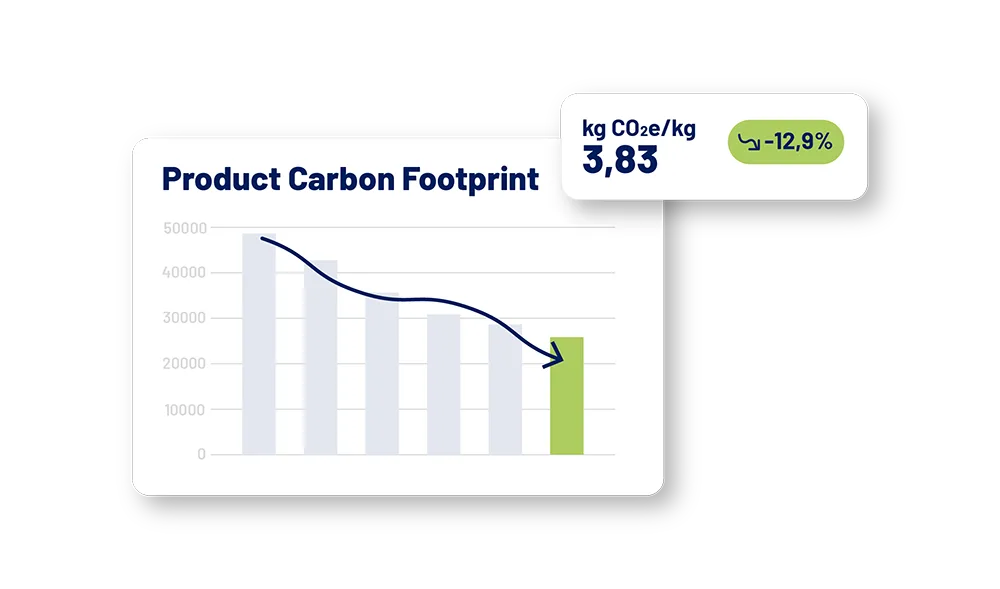
TELUSIO offers a holistic solution that includes both the software needed for the carbon accounting of services and expert support. This ensures the correct implementation of the relevant standards, so that the relevant emission sources are identified and calculations are carried out in line with recognised standards.
Conclusion: the need for carbon accounting for services
Carbon accounting in the service sector is an indispensable step for companies on the way to a sustainable future. But the complexity of the calculations, the variety of relevant emission sources and the need for expertise in ISO 14067 and other standards make this process demanding. Without the right support, errors can easily occur that distort the CO2 value and make competition harder.

Your customer is asking for a PCF?Let’s talk.
Discover the easiest way to audit-ready PCFs – AI-powered and expert-reviewed.
Book an initial call