
Blog
Insights from PCF practice
Studies, analyses and experience from projects with industrial companies.Articles are currently available in German only.

Articles are currently available in German only.

The importance of sustainability and the integration of ESG criteria (environmental, social, governance) into corporate strategy are growing steadily. A key component of this integration process is the materiality assessment.
This guide provides a detailed overview of the materiality assessment and shows how companies can improve their ESG performance through systematic assessment and prioritisation of their goals and measures.
What is a materiality assessment?
A materiality assessment is a systematic process in which companies identify the most important ESG topics that have a significant impact on their business and their stakeholders. This assessment helps companies use their resources efficiently and shape their sustainability strategy (CSR) in a targeted way.
What is a double materiality assessment?
A central concept of ESG reporting for companies is the double materiality assessment, which is anchored in the CSRD . This concept states that companies must assess both the financial impact of sustainability factors on the company and the company’s impact on the environment and society.
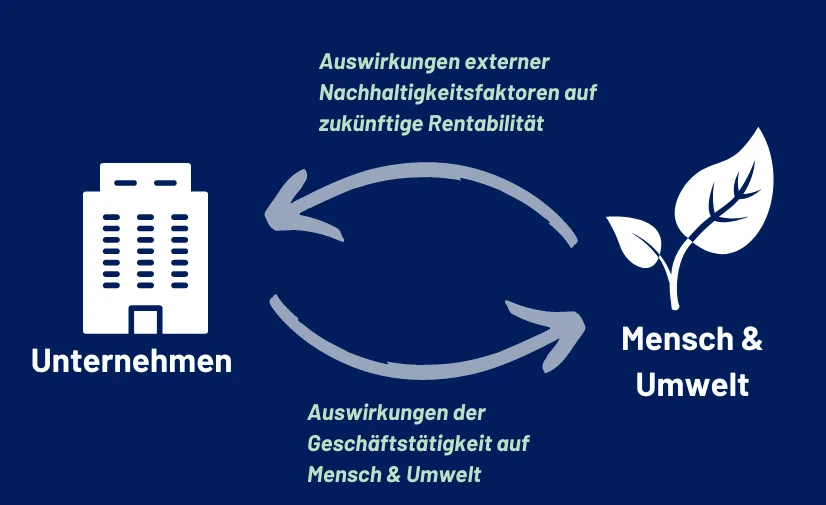
Financial materiality (outside-in perspective)
Looks at how environmental and social factors can influence the company’s economic performance and value.
Impact materiality (inside-out perspective)
Assesses how the company’s business activities affect the environment and society.
Why is the materiality assessment important?
The materiality assessment is of central importance for companies to optimise their ESG performance:
- Prioritising ESG topics: companies can identify the topics that have the greatest impact on their business and stakeholders and prioritise them.
- Resource efficiency: by focusing on material ESG topics, companies can use their resources more effectively.
- Stakeholder communication: transparent communication about material ESG topics strengthens trust and credibility with stakeholders.
- Risk management: companies can identify potential risks early and take measures to minimise them.
In addition, the double materiality assessment is a central part of the CSRD. It is therefore mandatory for identifying the topics that must be reported on. An early analysis should therefore not be underestimated.
Steps for carrying out a materiality assessment

1. Preparation and planning
The first step involves defining the framework for the materiality assessment. This includes defining the objectives, determining the relevant stakeholders and selecting the assessment methods. An organisational scope must be defined to ensure that all relevant departments and business units are included.
2. Identifying relevant ESG topics
In this phase, potential ESG topics that could be relevant to the company are identified. This can be done by reviewing internal documents, industry reports, legal requirements and international standards such as the GRI Standards.
3. Stakeholder survey
Involving stakeholders is an essential part of the materiality assessment. Companies should survey a wide range of stakeholders, including employees, customers, suppliers, investors and communities, to understand their perspectives and expectations.
4. Prioritising the topics
After capturing stakeholder opinions, the identified ESG topics are assessed and prioritised. A matrix is often used that shows the importance of the topics from the perspective of both the company and the stakeholders. The most important topics, which are highly relevant to both the company and the stakeholders, are classified as material.
5. Validation and review
The prioritised topics are then validated and reviewed. This can be done through internal workshops and discussions with executives and subject matter experts. The aim is to ensure that the assessment is consistent and robust. The entire senior management should be involved to ensure the strategic relevance and implementation of the ESG topics.
6. Integration into corporate strategy
The material ESG topics identified should be integrated into corporate strategy and processes. This includes setting targets, developing action plans and assigning responsibilities. Continuous monitoring and reporting on progress are crucial to the success of the ESG strategy.
Telusio’s view
A materiality assessment is an indispensable instrument for companies that want to optimise their ESG performance. By systematically identifying and prioritising material ESG topics, companies can use their resources efficiently, manage risks better and strengthen the trust of their stakeholders. Through a targeted materiality assessment, SMEs can not only operate more sustainably but also remain competitive and successful in the long term.
The double materiality assessment is a central part of the CSRD and should therefore not be underestimated. It is important to carry it out thoroughly in order to identify the aspects that must be reported on and to prepare in good time.
Integrating ESG into corporate strategy is an ongoing process that requires constant adjustment and improvement. A solid materiality assessment forms the basis for sustainable and forward-looking corporate management.



Your customer is asking for a PCF?Let’s talk.
Discover the easiest way to audit-ready PCFs – AI-powered and expert-reviewed.
Book an initial call