
Blog
Insights from PCF practice
Studies, analyses and experience from projects with industrial companies.Articles are currently available in German only.
Articles are currently available in German only.
What is Corporate Social Responsibility (CSR)?
Corporate Social Responsibility (CSR) – the social responsibility of companies – refers to the ethical obligation of companies to shape their business practices in such a way that they have a positive impact on society and the environment.
According to the EU Commission, CSR is “the responsibility of enterprises for their impacts on society”.
Corporate Social Responsibility (CSR) is not a legally prescribed set of rules and therefore does not define specific measures. Rather, it is a business concept that serves companies as guidance for meeting this responsibility and integrating ESG criteria into their business strategy.
How are CSR measures reported?

The report on the disclosure of non-financial information supplements the traditional annual report, which focuses mainly on the company’s financial development. The sustainability report focuses on the social, environmental and ethical aspects of corporate governance and provides a comprehensive insight into a company’s commitment to sustainability and social responsibility.
What are the goals of CSR measures?
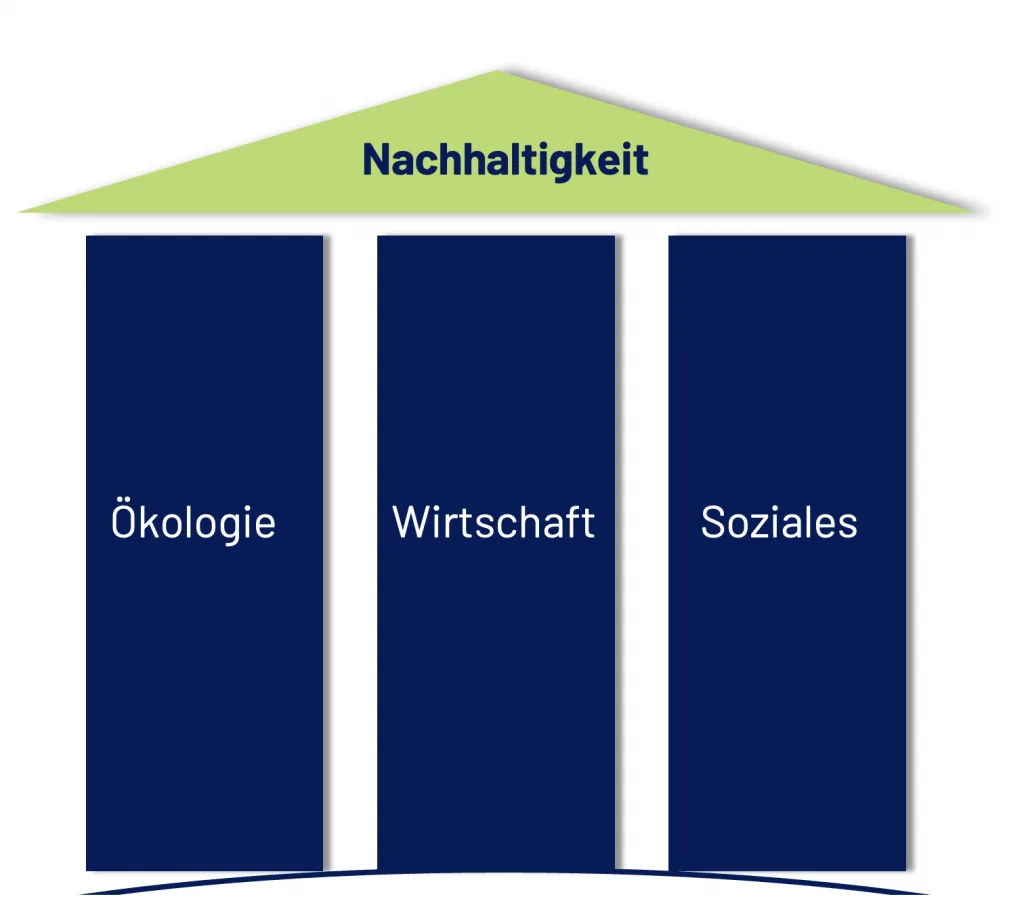
The goals of Corporate Social Responsibility are derived from the three-pillar model of sustainable business and therefore correspond to the ESG criteria.
According to the model, economy, environment and society are of equal rank and should be weighted equally. Corporate Social Responsibility (CSR) therefore serves to promote environmental, economic and social sustainability:
Environmental sustainability
Companies should handle the Earth’s natural resources responsibly and take care not to overexploit them. The aim is to burden the environment only to the extent that it can fully regenerate and that the basis of life for humans and animals is preserved in the long term.
Economic sustainability
A sustainable way of doing business is characterised by the fact that it can be operated permanently and responsibly. Companies should design their business practices so that they not only remain financially healthy but also secure their economic stability for future generations. Short-term profits must not jeopardise long-term stability.
Social sustainability
Companies should promote social cohesion and peaceful coexistence instead of causing or aggravating conflicts.
To work out and prioritise the most relevant measures for its own business individually, a company should first carry out a materiality analysis so that it can then tackle targeted CSR measures.
What are the benefits of implementing CSR measures?

Improving the corporate image: a strong CSR strategy can improve a company’s image and strengthen the trust of customers, investors and the public.
Competitive advantage: companies that take on social and environmental responsibility can stand out from the competition and build a loyal customer base.
Employee retention and motivation: CSR initiatives can increase employee satisfaction and loyalty, leading to higher productivity and lower turnover.
Risk management: through proactive CSR measures, companies can better manage potential environmental, social and governance (ESG) risks and secure long-term stability.
Innovation: CSR can promote innovation, as companies look for new ways to operate more sustainably and improve their products and services.
Criticism of the concept of Corporate Social Responsibility
Despite general recognition of the importance of CSR principles, there is also criticism of this model:
Non-binding nature: critics complain that CSR is non-binding and contains no concrete measures, which leads many companies to deal with it at a theoretical level without taking practical steps.
Voluntariness: the voluntary model of CSR is often criticised because it mainly serves to prevent stricter laws and tougher standards that would force companies to become more sustainable.
Greenwashing: critics complain that companies often introduce CSR as pure cosmetics to improve their image, increase sales and attract new employees more easily. This is often referred to as a form of “greenwashing”.
Telusio’s view
Corporate Social Responsibility is more than just a buzzword; it is an essential component of modern business practice. By embracing CSR, companies can not only fulfil their social responsibility but also achieve long-term benefits. A well-thought-out and well-implemented CSR strategy helps make the company future-proof while having a positive impact on the world.
For CSR to be effective, it should be deeply integrated into the entire corporate culture and closely linked to the core business. Isolated actions such as donations to charities are not enough to represent a comprehensive CSR strategy.




Your customer is asking for a PCF?Let’s talk.
Discover the easiest way to audit-ready PCFs – AI-powered and expert-reviewed.
Book an initial call