
Blog
Insights from PCF practice
Studies, analyses and experience from projects with industrial companies.Articles are currently available in German only.
July 1, 2024 · 3 min read · Dr. Johannes Weibl
European Sustainability Reporting Standards (ESRS)
Articles are currently available in German only.
In today’s business world, sustainability is becoming increasingly important. Companies worldwide face the challenge of reporting their environmental, social and governance (ESG) performance in a transparent and comparable way.
To ensure this, the uniform European reporting standards that companies must use when preparing their reports are an essential part of the newly introduced rules on sustainability reporting (CSRD). These “European Sustainability Reporting Standards” (ESRS) are adopted by the European Commission as delegated acts and thus become applicable law. The drafts of these standards are developed by expert groups of the European Financial Reporting Advisory Group (EFRAG) on behalf of the European Commission.
The reporting standards are developed and adopted in several phases:
Phase 1: twelve reporting standards, including ten on environmental, social and governance topics and two standards with general requirements, were adopted as a delegated regulation of the European Commission on 31 July 2023 and have been in force since 2024.
Phase 2: simplified reporting standards for listed small and medium-sized enterprises and possible extensions for phase 1 are to be published. The delegated acts were due to be published by 30 June 2024; currently three implementation guidance documents are available.
Phase 3 and beyond: sector-specific reporting standards and standards for companies from third countries are planned. The corresponding delegated acts are scheduled for publication by 30 June 2026.
Core components of the European Sustainability Reporting Standards (ESRS)
Cross-cutting standards
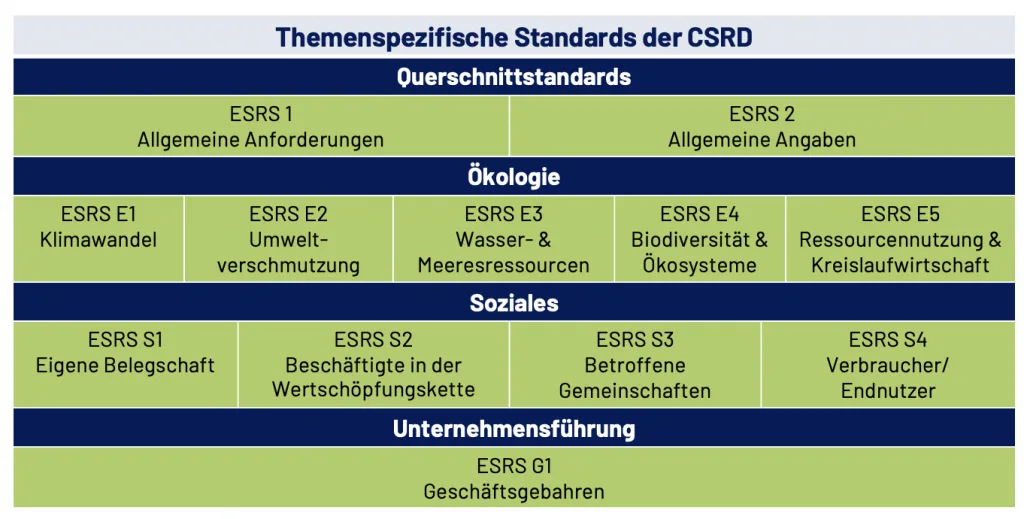
ESRS 1 sets out the general requirements for a company’s sustainability reporting. It defines the rules for applying the standards and the structure and principles of the reports. ESRS 2 defines the cross-cutting reporting requirements and mandatory disclosures.
Topical standards
The environmental area covers five different topics, the social area comprises four standards, and a further category on governance has been introduced.
Harmonising international non-financial reporting through the ESRS
The ESRS therefore harmonise international non-financial reporting at several levels:

Consistent standards:
The ESRS provide a common reporting framework based on international best practices. This reduces the differences between the various reporting standards and makes it easier to compare companies’ ESG performance worldwide.
Integration with global initiatives:
The ESRS are designed to be compatible with other international frameworks such as the Global Reporting Initiative (GRI) Standards, the Sustainability Accounting Standards Board (SASB) Standards and the recommendations of the Task Force on Climate-related Financial Disclosures (TCFD). This promotes uniform reporting at global level.
Promoting transparency and trust:
The mandatory disclosure of ESG data in accordance with the ESRS enables stakeholders, including investors, customers and regulators, to make informed decisions. This strengthens trust in the reported data and promotes sustainable investment and business strategies.
Telusio’s view
The European Sustainability Reporting Standards (ESRS) play a crucial role in harmonising international non-financial reporting.
By providing uniform standards and integrating with global initiatives, the ESRS promote the transparency, comparability and reliability of companies’ ESG reports. This not only supports the achievement of the EU’s sustainability goals but also helps companies worldwide adopt more sustainable practices and continuously improve their ESG performance.
Further information is also available on the website of the German Environment Agency.




Your customer is asking for a PCF?Let’s talk.
Discover the easiest way to audit-ready PCFs – AI-powered and expert-reviewed.
Book an initial call