
Blog
Insights from PCF practice
Studies, analyses and experience from projects with industrial companies.Articles are currently available in German only.
February 11, 2025 · 4 min read · Dr. Johannes Weibl
Efficiency Through Data Modelling: How TELUSIO Simplifies Scope 3 and PCF Calculations
Articles are currently available in German only.
The clock is ticking. Companies are under increasing pressure to make their emissions transparent – not only at company level, but also at product level.
Regulations such as the Corporate Sustainability Reporting Directive (CSRD) and initiatives such as the Science Based Targets initiative (SBTi) demand increasing disclosure of the entire emissions balance.
A look at the figures quickly shows where the challenge lies: most emissions arise in the supply chain – the so-called Scope 3 emissions. Purchased goods and services (Scope 3.1) are particularly relevant, as they often account for the largest share of a company’s carbon footprint.
But transparency often ends where control over the supply chain stops. Information on the exact materials, production steps or emissions of purchased goods is often incomplete, of poor quality or not available at all. A real problem when it comes to transparently disclosing purchased emissions and using the data points for further calculations.

But there is a solution: AI-based data modelling in accordance with ISO 14067 can help and ensure complete and transparent data points within the company – whether material, weight or emission values.
PCF calculation: why data gaps are a problem
In addition to transparency in Scope 3 emissions, calculating the Product Carbon Footprint (PCF) is also becoming increasingly important. The PCF covers the emissions a product causes during its entire life cycle – from manufacturing through distribution to disposal. PCF values offer clear advantages: they identify emission hotspots and create transparency.
But this is where the challenge begins: without precise master data on the materials, weights and emissions of purchased goods, the basis for an exact and complete carbon footprint is often missing.
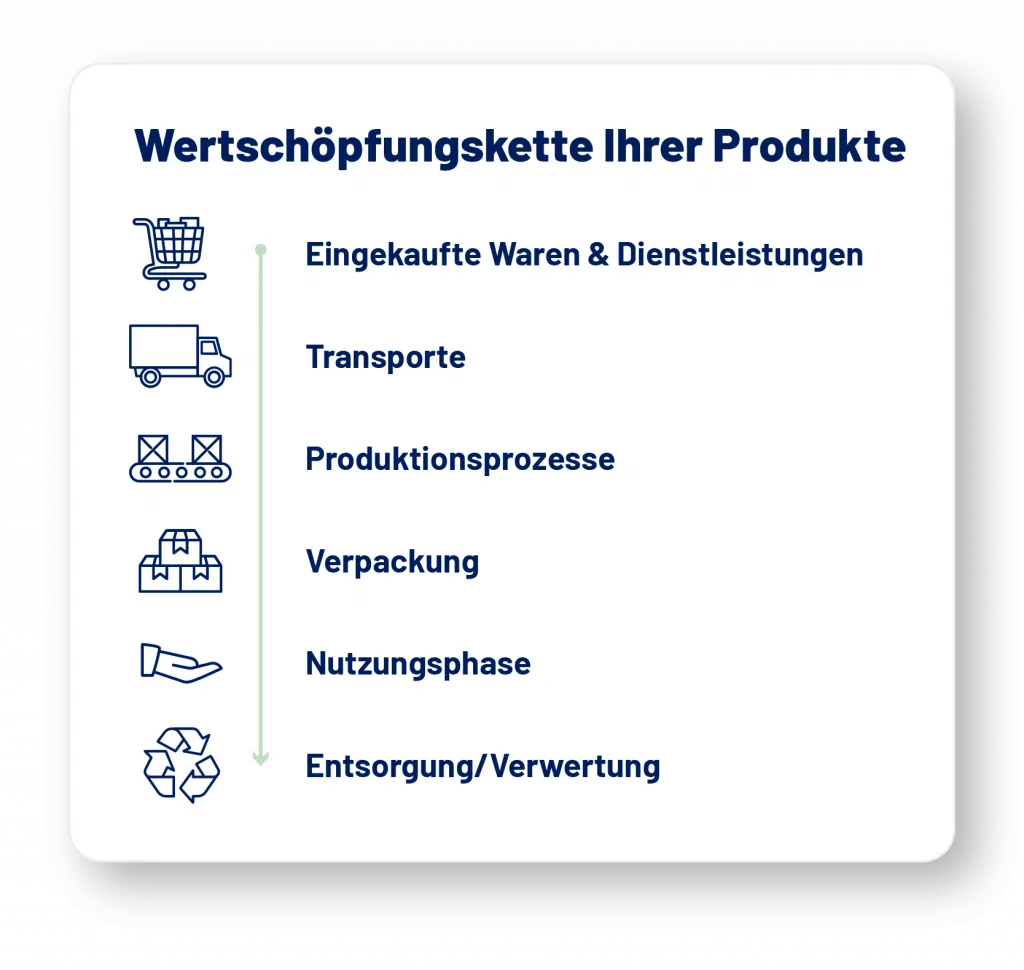
Companies then face a choice:
is it worth approaching suppliers again to ask for exact data? Will this data meet my quality requirements? Or do emissions, weights and materials simply have to be estimated? Both approaches are inefficient and error-prone.
Why procurement is the key
But how can the problem be tackled and procurement made more sustainable and efficient in the long term?
Sustainable procurement starts with a strategic development of purchasing processes towards data-based decisions. The term “procurement maturity” describes this maturing process: from a purely cost-oriented approach to data-driven and sustainable procurement. Why is this so crucial? Because mature procurement creates transparency and makes it possible to take CO2 data into account as early as supplier selection.
As a study by McKinsey shows, the digitalisation of procurement processes is a key lever for increasing transparency and efficiency in the supply chain.
But the potential goes further:
data captured once – for example on emission values, weights and materials – can flow directly into the PCF calculation of the end products. Individual parts whose emissions were already recorded during purchasing do not need to be analysed again. Instead, they flow seamlessly into the calculation of the entire product life cycle.
This saves time and resources and increases accuracy.
TELUSIO: data modelling for more efficiency and sustainability
But what if this data is missing?
This is where TELUSIO comes in. The software starts exactly where many companies reach their limits: missing or incomplete procurement data.
Using AI-supported algorithms, TELUSIO automatically models missing information – from materials and weights to emission values. This not only optimises the Scope 3 calculation but also considerably simplifies the PCF calculation. This approach proves itself even for complex products with numerous components. TELUSIO breaks products down into their individual parts and determines precise values – from black box to full transparency.
This data can be integrated directly into purchasing processes, creating a consistent and precise data basis. In addition to filling existing data gaps, the modelling can also be used to assess the quality of suppliers’ primary data. Are the primary values realistic? Can I include them in my calculation with a clear conscience? – a crucial step for securing data quality in the long term.
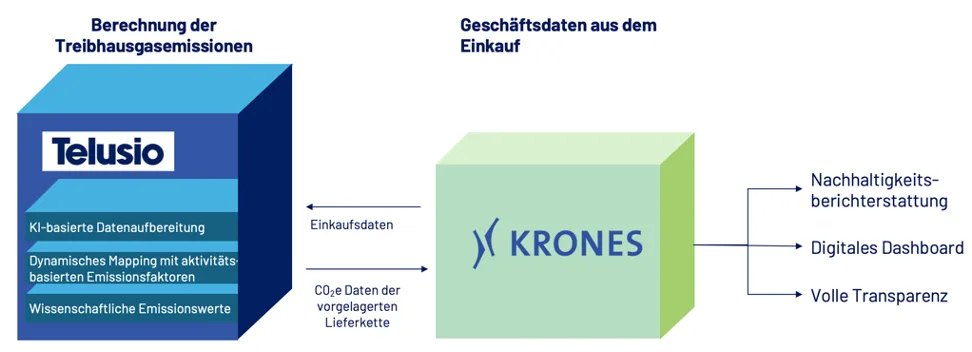
Figure: data modelling in procurement at Krones
One example of the successful application of this solution is the collaboration with Krones. With TELUSIO, Krones was able to tackle Scope 3 reporting and reduction and dynamically calculate the emission values of more than 100,000 purchased goods. The transparency achieved enabled not only a greater focus on sustainability in supplier selection, but also a resource-saving calculation of the PCF values of the machines produced.
Creating synergies: from procurement to PCF calculation
Data captured or modelled once in procurement can be used efficiently for further steps. It enables seamless integration into the PCF calculation without having to estimate or collect data again.
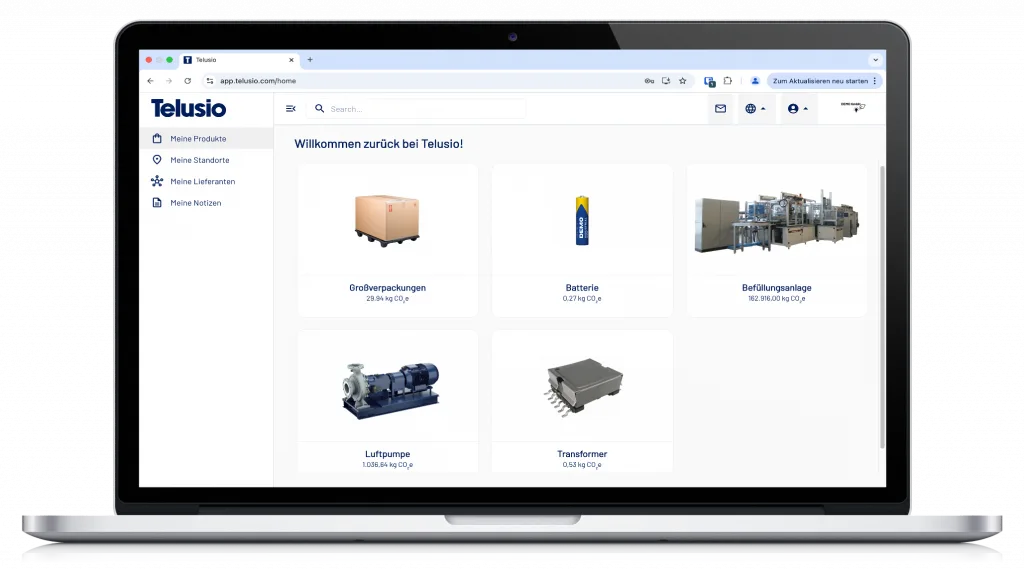
The result? A straightforward, fast and resource-saving PCF calculation that meets high quality standards and is also ISO-compliant. As well as consistency and transparency across the entire organisation.
Conclusion: sustainability starts in procurement
Modelling and filling in missing procurement data is the key to precise and efficient emission calculations, both at company and product level. TELUSIO offers the solution that helps companies create a consistent data basis, save resources and increase transparency. Sustainability starts in procurement – and TELUSIO shows how.




Your customer is asking for a PCF?Let’s talk.
Discover the easiest way to audit-ready PCFs – AI-powered and expert-reviewed.
Book an initial call