
Blog
Insights from PCF practice
Studies, analyses and experience from projects with industrial companies.Articles are currently available in German only.
Articles are currently available in German only.
The EU Taxonomy is an important framework for promoting sustainable economic activities within the European Union. It was created to define the term “sustainable” precisely and thus ensure that financial flows are directed specifically into demonstrably “sustainable” technologies and companies.
From 2025, companies that publish a sustainability report in accordance with the Corporate Sustainability Reporting Directive (CSRD) are obliged to apply Article 8 of the EU Taxonomy Regulation. This means that, in addition to quantitative taxonomy key figures on relevant (“taxonomy-eligible”) economic activities, they must also provide an explanatory description of their sustainability practices. Large listed companies with more than 500 employees have already implemented this requirement since 2021.
The environmental objectives of the EU Taxonomy
Based on the EU Taxonomy, six environmental objectives were introduced against which the sustainability of a business activity can be assessed.
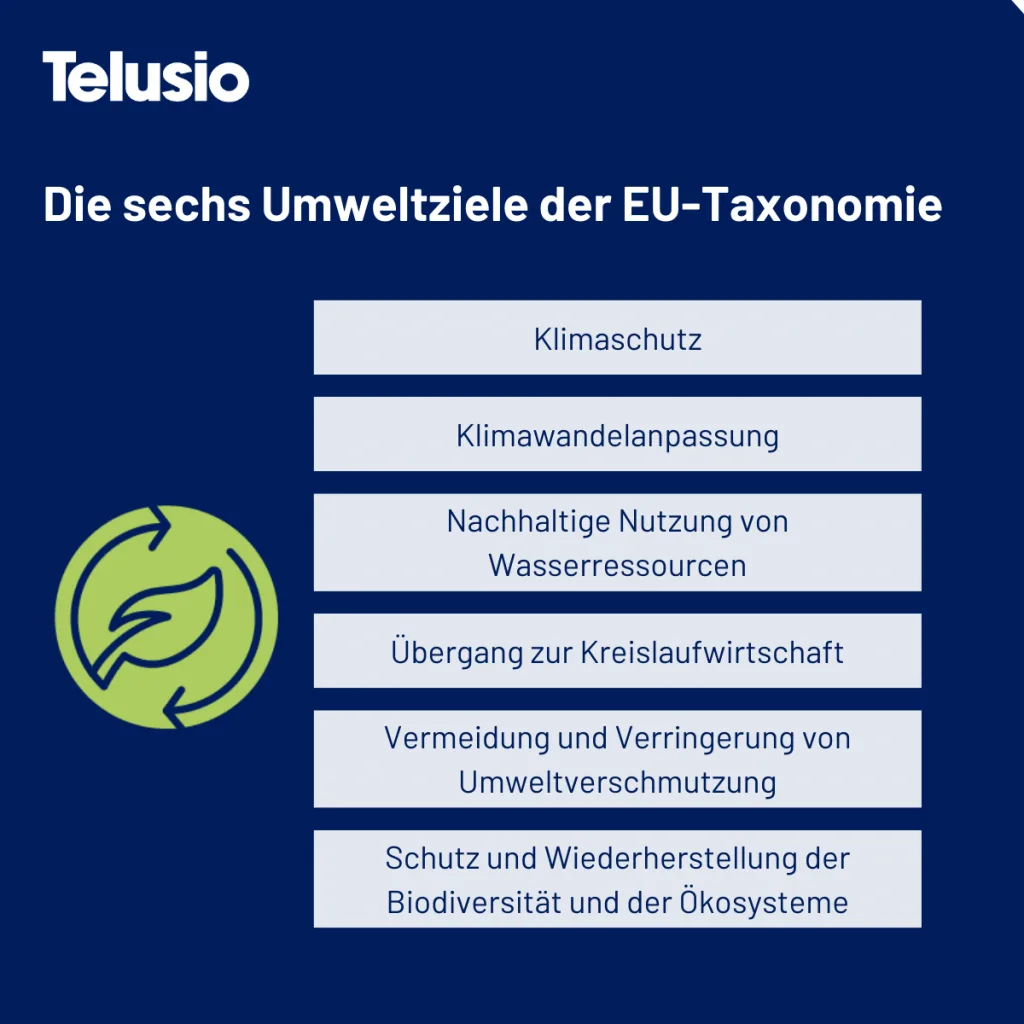
A business activity is only classified as sustainable if it meets the following criteria:
– Substantial contribution:
–> contributes to at least one of the environmental objectives of the Taxonomy Regulation
– Do no significant harm:
–> does not significantly harm any other environmental objective
– Minimum safeguards:
–> complies with minimum social standards
What steps are needed to classify activities as “sustainable”?
The EU Taxonomy classifies companies using concrete key figures that assess their ability to contribute substantially to the EU environmental objectives (taxonomy eligibility) and their current contribution to these objectives (taxonomy alignment):
1. Selecting relevant activities
The EU Taxonomy Regulation contains a catalogue of different activities that could have a positive effect on the EU environmental objectives. From this catalogue, all activities that apply to the company must be identified.
–> The activity is taxonomy-eligible
2. Calculating the potential contribution to the climate objectives
To check the materiality of the contribution, it is expressed as three key figures: in relation to turnover, capital expenditure and operating expenditure.
3. Checking taxonomy alignment
If the activity meets the technical screening criteria (i.e. a substantial contribution can be demonstrated), does not harm any other environmental objective and complies with the minimum social standards, it can be assessed as contributing to the achievement of the environmental objectives.
–> The activity is taxonomy-aligned
4. Disclosure in the company’s financial statements
The activities and the associated turnover, capital and operating expenditure can be shown in the financial statements (as a ratio or percentage) as taxonomy-aligned and thus “sustainable”.
When do companies need to act?
The timetable requires companies to disclose the share of their eligible activities since January 2022 and to report on the alignment of their activities with the taxonomy objectives from January 2024.
From 2025, financial institutions must take taxonomy alignment into account in their non-financial reports in accordance with the CSRD rules. This gradual implementation aims to oblige companies by 2025 to report on the share of their taxonomy-aligned activities in turnover, capital expenditure and operating expenditure.


Your customer is asking for a PCF?Let’s talk.
Discover the easiest way to audit-ready PCFs – AI-powered and expert-reviewed.
Book an initial call