
Blog
Insights from PCF practice
Studies, analyses and experience from projects with industrial companies.Articles are currently available in German only.
April 14, 2025 · 5 min read · Dr. Johannes Weibl
10 Challenges of Calculating Product Carbon Footprints Manually

Articles are currently available in German only.
The requirements for a precise and traceable carbon footprint are rising – driven, for example, by CSRD reporting obligations, corporate sustainability strategies and the growing importance of climate data in the supply chain.
Nevertheless, many companies still rely on classic spreadsheets such as Excel to determine their Product Carbon Footprints (PCFs). Using ten aspects, we show the typical challenges and difficulties that spreadsheets bring to Product Carbon Footprint calculation:
1. Error-proneness endangers calculation quality
Because spreadsheets are created manually, the risk of input or formula errors is naturally higher than with fully automated solutions. This risk is particularly pronounced for complex calculations such as the Product Carbon Footprint, which requires data from different departments of a company or from external sources. A single transposed digit can distort the entire Product Carbon Footprint and lead to inaccurate CO2 values.
2. Complex bill of materials logic
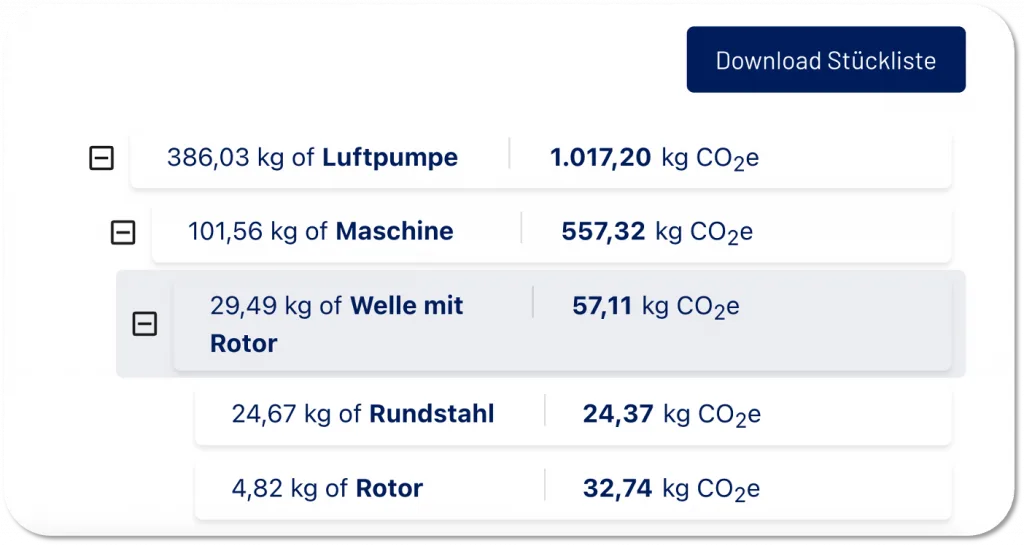
Product Carbon Footprint calculation is often based on complex bills of materials with several hierarchy levels – especially for assemblies, modular products or variants. In spreadsheet tools, these structures must be mapped manually and resolved correctly in order to allocate material quantities, weights and emission factors properly. Without automated BOM logic, it is much harder to follow the actual structure of a product consistently – which quickly leads to calculation errors and incorrect allocations.
3. No automatic data validation
A Product Carbon Footprint depends heavily on the quality of the underlying data. With spreadsheets, however, the challenge is that outliers or incorrect units are not detected automatically. The use of unsuitable emission factors can also go unnoticed, increasing the risk of imprecise results. As the calculations are often complex and hard to follow, such inaccuracies can easily be overlooked. In the worst case, this leads to flawed results that damage the company’s credibility and reputation.
4. Manual PCF review: time-consuming due to unverified calculation methodology
Manual calculation methods usually lack system-side verification of the calculation methodology. This means that every Product Carbon Footprint report has to be checked individually – a time-consuming and costly process. Fully automated software solutions offer a decisive advantage here: once the calculation logic has been certified, the review can focus directly on the results – saving time, reducing effort and increasing audit confidence.

5. Unsuitable for collaborative Product Carbon Footprint work
Especially for carbon footprints, interdisciplinary teams work together on one file. Spreadsheets can make collaboration tedious – with version conflicts, missing change tracking and sometimes confusing filing structures.
6. Missing data turns tools like Excel into a never-ending construction site
An often underestimated problem in Product Carbon Footprint calculation is the lack of key product data – for example on material composition, weight or origin of individual components. Especially in the complex bills of materials of larger companies, there are regularly information gaps, as this data was often historically not collected or systematically documented.
When working with spreadsheets, every missing piece of information has to be researched, added and traced manually – often line by line. This is not only extremely time-consuming but also prone to errors, assumptions and inconsistencies.
Modern software solutions offer clear advantages here. They “learn” as they go, recognise patterns in bills of materials, fill in missing data automatically and enable much more efficient allocation. Missing information can be flagged systematically, suppliers involved directly and data follow-up workflows automated. With spreadsheets, by contrast, missing information has to be added manually – a considerable effort that quickly multiplies as the product portfolio grows.
The more data is missing, the less accurate the Product Carbon Footprint – and the greater the effort to calculate it.
7. Insufficient system integration
Some companies use the integration of primary data to calculate their Product Carbon Footprint. This data is based on real-time information – e.g. from ERP, energy management or accounting systems. This allows emissions to be recorded more up to date, more accurately and with less manual effort. Spreadsheet tools, however, cannot connect these sources automatically, so the data has to be transferred, adjusted and entered by hand – an enormous loss of efficiency as data volumes grow.
8. High effort for maintaining emission factors
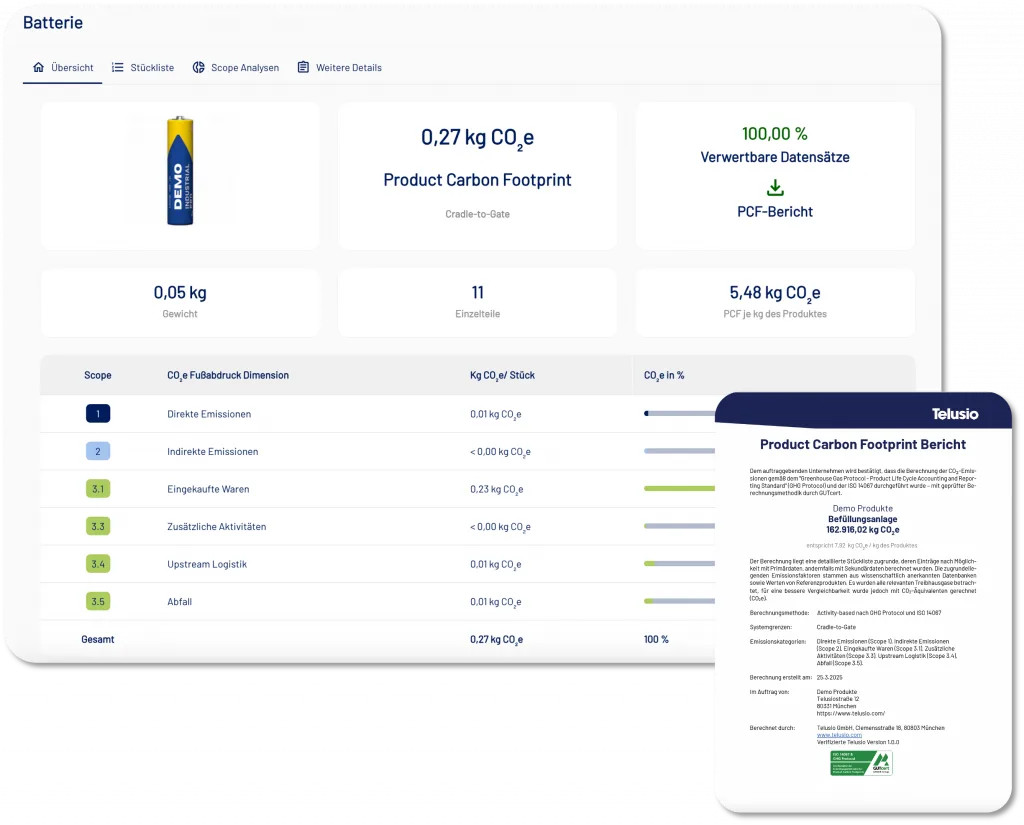
Emission factors must be updated regularly – whether due to changed values, new scientific findings or additional data sets for previously uncovered materials. In spreadsheet tools, such changes have to be tracked manually and assigned to each affected product individually. This is not only time-consuming but also carries a high potential for errors.
9. Scaling? Not a chance!
The more products, sites and suppliers are included in the Product Carbon Footprint calculation, the larger and more complex the spreadsheet can become. As the required data often comes from different departments – often in different formats, time periods or system versions – manual harmonisation is necessary.
This can be time-consuming and opens up the possibility of errors, which can make consistent calculation at company level more difficult. In practice, it can also be challenging to reliably process and evaluate large and heterogeneous data volumes using spreadsheets.
10. Insufficient transparency in reporting and auditing
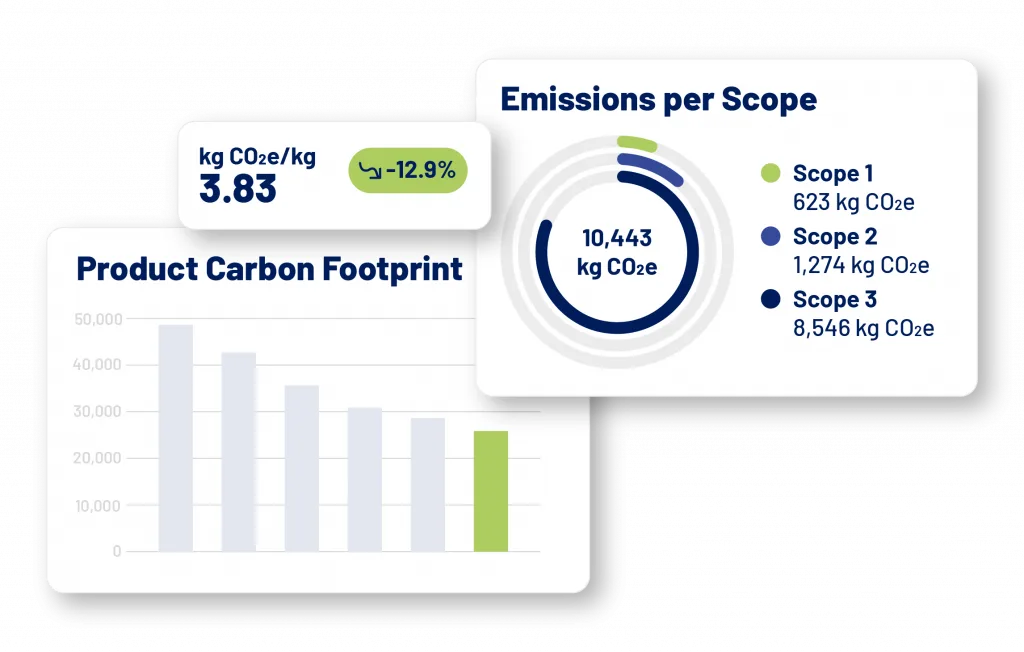
Product Carbon Footprint results must be evaluated internally, audited externally and increasingly also disclosed for regulatory purposes – e.g. as part of the CSRD or ESG reports. Spreadsheets reach their limits here: standardised evaluations, dynamic dashboards and traceable data paths are often missing. In addition, the calculation logic is often hidden in individual formulas, which can make auditing harder. For internal managers and external auditors, consistent and trustworthy reporting can therefore become demanding.
Conclusion: spreadsheets hit efficiency limits for Product Carbon Footprints
A professional Product Carbon Footprint is the foundation for strategic climate management. Those who still rely on spreadsheets today risk inaccurate data, inefficient processes and unnecessarily high personnel costs.
We see every day how resource-intensive Product Carbon Footprint calculation is for companies – especially when it is based on spreadsheets. The problem is exacerbated by faulty, incomplete or poorly structured bills of materials, which are supposed to serve as the basis for the calculation. On top of this comes limited access to reliable and sufficiently detailed emission data. This often requires paid third-party databases.
Modern software solutions for Product Carbon Footprint calculation offer companies security, automation and future viability – decisive advantages in a dynamic market environment.


Your customer is asking for a PCF?Let’s talk.
Discover the easiest way to audit-ready PCFs – AI-powered and expert-reviewed.
Book an initial call