
Blog
Insights from PCF practice
Studies, analyses and experience from projects with industrial companies.Articles are currently available in German only.

Articles are currently available in German only.
As of: November 2025
Since 18 November 2025, the European Council, European Parliament and European Commission have been in trilogue negotiations on changes to the Corporate Sustainability Reporting Directive (CSRD), the Corporate Sustainability Due Diligence Directive (CSDDD) and the EU Taxonomy Regulation. These negotiations are expected to bring far-reaching changes, in particular postponing most reporting obligations and adjusting the thresholds for reporting obligations. The core objectives and basic concepts of the directives, however, remain essentially unchanged. This article looks at the current state of the political negotiations.
1. Background of the CSDDD
On 23 February 2022, the European Commission adopted a proposal for a directive on corporate sustainability due diligence (CSDDD). More than two years later, on 24 May 2024, the Council of the European Union approved the political agreement, completing the adoption procedure (Directive (EU) 2024/1760). The directive has been in force since 25 July 2024.
The aim of the CSDDD is to oblige companies to identify, prevent, mitigate and remedy human rights and environmental risks in their own operations and along the “chain of activities” (supply chains and key distribution chains). This includes, among other things:
- systematic risk analysis and prioritisation of risks,
- prevention and remediation measures, including towards business partners,
- complaints mechanisms,
- monitoring and effectiveness checks,
- publication of key information (typically in the CSRD sustainability report).
The CSDDD goes beyond the German Supply Chain Due Diligence Act (LkSG) in several respects – for example through the extended “chain of activities”, civil liability and an explicitly anchored obligation for climate transition planning. These measures aim to bring about a comprehensive transformation of business practices and put sustainability at the heart of corporate strategies.
2. What do companies have to report on under the CSDDD?
Under the CSDDD, companies must report on compliance with due diligence obligations .
From 2028, companies are obliged in their ESG reporting to identify negative environmental and human rights impacts in their supply chains and explain methods for preventing or mitigating these impacts. In addition, affected parties become entitled to compensation, and national supervisory authorities are set up to impose fines and issue compliance orders.
Another key element of the CSDDD is the obligation for companies to end business relationships if serious negative impacts on the environment or human rights are identified that cannot be remedied.
3. Implementation of the CSDDD
Current development:
According to the current position of Parliament, the CSDDD will only affect very large companies. The planned scope (not yet adopted into law!) is to apply from 5,000 employees and €1.5 billion turnover.
Until now, the CSDDD applied in principle to the following groups (for current developments see section 4):
- EU companies with, as a rule, more than 1,000 employees and more than €450 million worldwide turnover,
- non-EU companies generating more than €450 million turnover in the EU
- certain franchise and licensing models (turnover ≥ €80 million, of which ≥ €22.5 million from royalties).
Postponement of deadlines (“stop-the-clock”):
Directive (EU) 2025/794 changed the timelines:
- the transposition deadline for member states is extended by one year,
- the first application stage of the CSDDD is also postponed by one year.
In practice, this means:
- national transposition of the CSDDD expected by 2027,
- application for the largest companies from 2028,
- full application for all companies in scope by around 2030.
The exact dates result from national transposition laws and should be checked regularly.
4. Political “slimming down” through the Omnibus package
EU Commission proposal (February 2025)
As part of the “Simplification Omnibus”, the European Commission proposed:
- CSRD: raising the threshold to companies with ≥ 1,000 employees (plus financial thresholds), reducing the companies previously covered by around 80%.
- CSDDD: focusing due diligence obligations mainly on direct business partners, longer risk analysis cycles, softening some obligations, but no change to the original thresholds (≥ 1,000 employees, €450 million).
Council position (June 2025)
In its “general approach”, the Council of the EU supported, among other things:
- CSRD only for companies with ≥ 1,000 employees and €450 million turnover,
- relief for small suppliers (limiting data requests),
- a moderate softening of the CSDDD obligations, but still well beyond national laws such as the LkSG.
Parliament position (13 November 2025)
On 13 November 2025, the European Parliament adopted a much more far-reaching slimming down:
- CSRD
- Scope: only companies with ≥ 1,750 employees and ≥ €450 million turnover.
- Sharp reduction in the number of companies required to report.
- CSDDD
- Applies only to companies with ≥ 5,000 employees and > €1.5 billion turnover (or corresponding EU turnover for non-EU companies).
- Deletion of the obligation for climate transition planning at EU level; this responsibility would shift more to national rules.
- Focusing due diligence obligations on direct business partners and stronger limits on information requests to SMEs in the supply chain.
This position is not yet applicable law but the starting point for the upcoming trilogue negotiations between the EU Council, EU Parliament and EU Commission (result expected: end of 2025).
Companies should nevertheless take it into account in scenario planning, as – if it prevails – it would drastically reduce the number of legally obliged companies, while leaving the (reputational) expectations of financial markets, customers and civil society largely unaffected.
5. What are the goals of the CSDDD and the CSRD?
Corporate Sustainability Due Diligence Directive (CSDDD)
The CSDDD aims to harmonise corporate due diligence obligations across the EU and anchor accountability in a binding way. It obliges companies to systematically identify, assess and effectively address environmental and human rights risks along their entire value chain.
Corporate Sustainability Reporting Directive (CSRD)
The central goal of the CSRD is to harmonise sustainability reporting in the EU and thereby significantly increase the transparency and comparability of sustainability information. It anchors the principle of double materiality as a fundamental assessment tool: companies must systematically analyse and report both their impact on the environment and society and the financial risks and opportunities that sustainability aspects pose for the company itself.
In addition, the CSRD establishes binding and detailed reporting standards intended to ensure that companies disclose consistent, reliable and traceable data on their sustainability performance.
The CSDDD and the CSRD pursue different but complementary goals: the CSDDD strengthens due diligence obligations along the value chain, while the CSRD aims at transparent and comparable sustainability reports.
6. What are the differences between the CSDDD and the CSRD?
The CSRD and the CSDDD are based on shared goals and values of responsible corporate governance, but differ significantly in their focus and requirements. The most important differences are explained below.
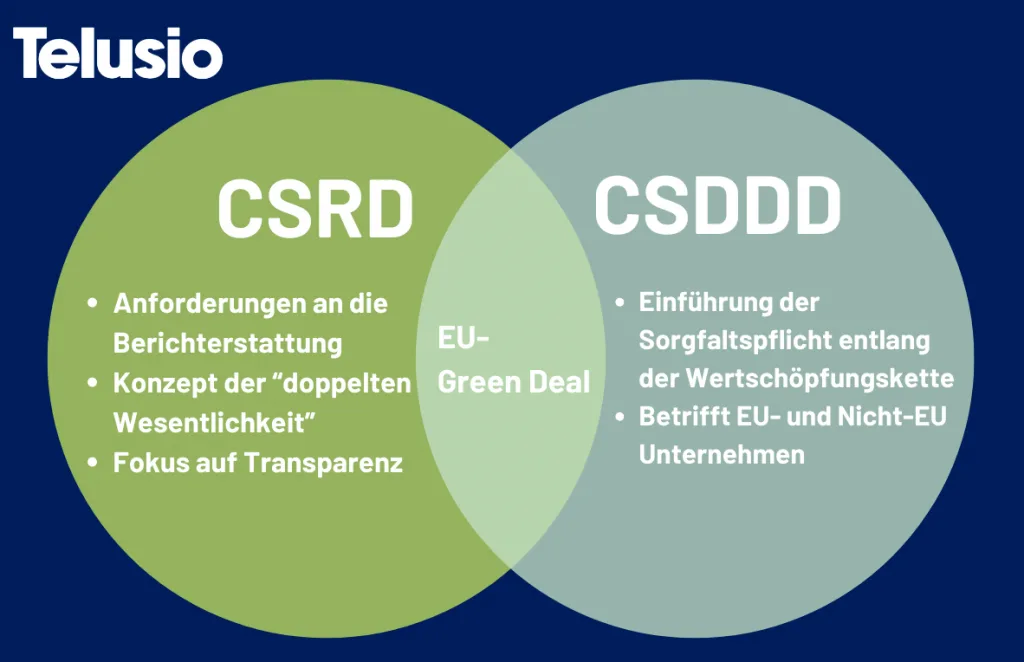
- Objective
- CSDDD: governs what companies have to do → due diligence, risk management, prevention, remediation, escalation.
- CSRD: governs how this is reported → transparency, disclosure, standardisation of ESG data.
- Focus of the directive
- CSDDD: operational processes and responsible business practices (supply chain, governance, human rights, environment).
- CSRD: structured ESG reporting according to fixed standards (ESRS).
- Type of obligations
- CSDDD:
- Obligations to act and processes: risk analyses, measures, complaints channels, possibly supplier exit.
- Liability risks (civil law) + regulatory sanctions.
- CSRD:
- Disclosure obligations: what must be reported and in what detail?
- No direct operational measures prescribed – but indirect pressure through transparency.
- CSDDD:
- Position in the value chain
- CSDDD: in-depth review of supply chains and active risk management.
- CSRD: description of the impact of the supply chain, without prescribing concrete measures.
- Internal embedding in the company
- CSDDD:
- Strong operational anchoring in purchasing, compliance, risk and supplier management.
- Need to realign internal processes and governance structures.
- CSRD:
- Focus on strategic ESG governance, reporting, data processes and auditability.
- Close collaboration between sustainability, finance and controlling.
- CSDDD:
- Sanction mechanisms
- CSDDD:
- Fines, regulatory orders and civil liability.
- Higher legal and financial risk.
- CSRD:
- Fines and audit requirements, but no liability to the same extent as under the CSDDD.
- CSDDD:
- Effect on companies
- CSDDD:
- Forces operational change and risk-based management in the supply chain.
- Anchors sustainability obligations at the core of the business model.
- CSRD:
- Forces structure, comparability and transparency in reporting.
- Anchors sustainability in management and reporting processes.
- CSDDD:
Relationship to each other
- The CSDDD creates the substantive due diligence obligations (including the climate plan under current law),
- the CSRD/ESRS provide the reporting framework in which these obligations – and their implementation – must be systematically disclosed.
In practice, this means:
- Without robust CSDDD processes, the CSRD report remains weak in substance.
- Without CSRD/ESRS, communicating CSDDD implementation is hard for stakeholders to compare.
Telusio’s view
Many companies will be significantly relieved by the new thresholds (as of November 2025). Nevertheless, sustainability reporting remains a key factor for customers, banks and investors. Companies should therefore continue to rely on clear data, even if they do not fall under the regulation.



Your customer is asking for a PCF?Let’s talk.
Discover the easiest way to audit-ready PCFs – AI-powered and expert-reviewed.
Book an initial call