
Blog
Insights from PCF practice
Studies, analyses and experience from projects with industrial companies.Articles are currently available in German only.
August 8, 2024 · 4 min read · Dr. Johannes Weibl
What Are the Sustainable Development Goals (SDGs)?
Articles are currently available in German only.
Background
At the Rio+20 conference in 2012, UN member states decided to develop goals for sustainable development, known as the Sustainable Development Goals (SDGs). Unlike the Millennium Development Goals, which mainly emphasised the social dimension of development, the SDGs were to put sustainability at the forefront. In addition to social aspects, this included economic and environmental aspects.
In September 2015, the 2030 Agenda for Sustainable Development was adopted by all UN member states. This agenda serves as a shared blueprint for peace and prosperity for people and the planet, now and in the future.
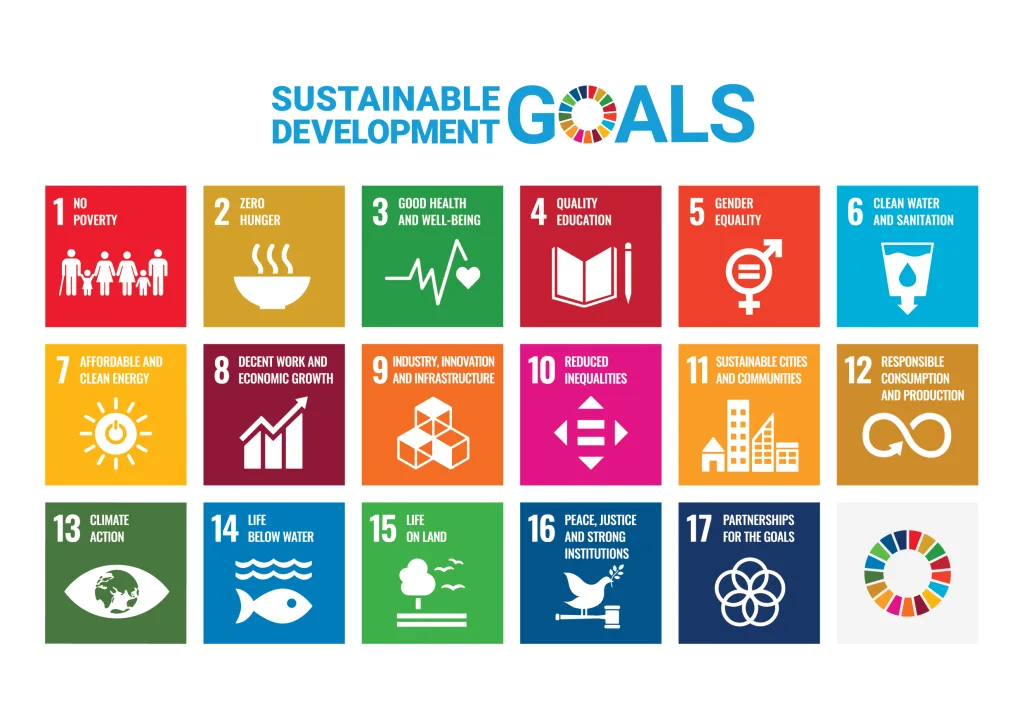
The 17 SDGs are at the heart of this agenda and aim to enable a decent life worldwide while preserving the natural foundations of life.
17 goals for a decent life
The 17 SDGs cover all three dimensions of sustainability: social, economic and environmental. Central aspects of the goals include economic growth, reducing disparities in living standards, creating equal opportunities and the sustainable use of natural resources. These goals are indivisible and interdependent, with a particular focus on disadvantaged and discriminated population groups.
The 17 goals are:
End poverty in all its forms everywhere
End hunger, achieve food security and improved nutrition and promote sustainable agriculture
Ensure healthy lives and promote well-being for all at all ages
Ensure inclusive and equitable quality education and promote lifelong learning opportunities for all
Achieve gender equality and empower all women and girls
Ensure availability and sustainable management of water and sanitation for all
Ensure access to affordable, reliable, sustainable and modern energy for all
Promote sustained, inclusive and sustainable economic growth, full and productive employment and decent work for all
Build resilient infrastructure, promote inclusive and sustainable industrialisation and foster innovation
Reduce inequality within and among countries
Make cities and human settlements inclusive, safe, resilient and sustainable
Ensure sustainable consumption and production patterns
Take urgent action to combat climate change and its impacts
Conserve and sustainably use the oceans, seas and marine resources for sustainable development
Protect, restore and promote sustainable use of terrestrial ecosystems, sustainably manage forests, combat desertification, and halt and reverse land degradation and halt biodiversity loss
Promote peaceful and inclusive societies for sustainable development, provide access to justice for all and build effective, accountable and inclusive institutions at all levels
Strengthen the means of implementation and revitalise the Global Partnership for Sustainable Development
Measuring the Sustainable Development Goals (SDGs)
To measure progress towards the SDGs, metrics and indicators have been developed that allow findings from climate science to be translated into the implementation of policy measures.
With the participation of the German Federal Statistical Office, a catalogue of indicators was drawn up and adopted by the UN Statistical Commission in March 2016. This measurement approach only takes into account data already available from national statistical offices. The UN Secretary-General’s annual SDG progress report is based on this global indicator framework and on data produced by national statistical systems. The annual progress reports can be accessed directly on the SDGs website.
Industrialised countries play a pioneering role
The German Federal Government emphasises that the leading industrialised and emerging countries in particular bear significant responsibility for achieving the sustainability goals. The G20 countries should take on a pioneering role in actively implementing the 2030 Agenda.
As one of the leading industrial nations, Germany bears a special responsibility, not only through national measures but also through international cooperation and support for developing countries. This pioneering role includes promoting sustainable technologies, developing and implementing policies to reduce emissions and supporting global partnerships for sustainable development.
Impact on German SMEs
The German Mittelstand comprises a wide range of companies, from traditional craft businesses to highly specialised technology firms. Regardless of their size or industry, all SMEs can benefit from integrating the SDGs into their business strategies.
Working with the SDGs has the advantage that SMEs can link their local sustainability efforts with a globally recognised framework.
The SDGs also provide a clear framework for sustainable business and help companies remain competitive in the long term, minimise risks and open up new business opportunities.
Telusio’s view
The SDGs offer German SMEs a unique opportunity to position themselves sustainably while securing economic success.
By integrating the SDGs into their business strategies, SMEs can not only contribute to solving global challenges but also strengthen their own future viability. In a world that increasingly values sustainability, SMEs that integrate these values into their actions will emerge as pioneers and winners.

Your customer is asking for a PCF?Let’s talk.
Discover the easiest way to audit-ready PCFs – AI-powered and expert-reviewed.
Book an initial call