
Blog
Insights from PCF practice
Studies, analyses and experience from projects with industrial companies.Articles are currently available in German only.
May 5, 2025 · 6 min read · Dr. Johannes Weibl
5 Tips for Successfully Implementing a Product Carbon Footprint Calculation

Articles are currently available in German only.
At first glance, calculating a Product Carbon Footprint (PCF) seems surprisingly simple: a product consists of several components whose CO2 emissions are recorded and then added up to a carbon footprint. A linear calculation – at least in theory.
In practice, however, it quickly becomes clear that determining a reliable PCF involves a variety of methodological, organisational and data-related challenges. This complexity is often underestimated, especially when the calculation is to be carried out and implemented internally.
The following five tips show what matters for a realistic and well-founded implementation if you want to take PCF calculation into your own hands at first, and how to avoid initial hurdles. This approach can make sense as part of a pilot project, a first manual analysis or in preparation for introducing software later.
1. Define system boundaries clearly
One of the first and most important decisions when calculating a Product Carbon Footprint concerns setting the system boundaries. They determine which process steps along the life cycle of the product in question are included in the PCF calculation.
System boundaries serve as a methodological framework and ensure comparability, consistency and traceability. Ideally, they are defined during the planning phase to avoid misunderstandings and clearly mark out the scope. The choice should be consistent with corporate sustainability goals – for example as part of ESG reports or requirements of the Science Based Targets initiative (SBTi).
The cradle-to-gate boundary is used particularly often: it covers all emissions from raw material extraction until the final product leaves the production site. This approach is often preferred in industry and between companies because it avoids double counting along the supply chain.
What exactly are system boundaries?
System boundaries define which life cycle phases of a product are considered when calculating the Product Carbon Footprint (PCF). They define the start and end point of emission recording – for example from raw material extraction to the factory gate (cradle-to-gate) or to disposal (cradle-to-grave). Depending on the chosen system boundary, the scope of emissions considered can vary greatly. The choice of system boundary therefore has a major influence on the significance and comparability of PCF results.
2. Capture data in a structured way and supplement it efficiently
A reliable data basis is the foundation of every PCF calculation – especially when it is carried out internally without external support. In practice, however, it often turns out that much product-related information is not available in the necessary depth or structure. Especially for complex products with long bills of materials, missing data can increase the effort considerably.
The focus is on the systematic recording of relevant master data, for example on processed materials, weights, quantities and – where possible – the origin of individual components. This information is necessary to allocate emissions correctly and make the calculation traceable.
For particularly meaningful results, it is advisable to use primary data – values actually collected in the company, such as the measured electricity consumption of individual manufacturing processes. They reflect actual conditions more accurately than general averages and allow more precise statements about a product’s carbon footprint. However, obtaining primary data from suppliers is still very difficult today, which is why calculating emissions using emission factors is recommended.
Emission factors are values that indicate how much greenhouse gas (e.g. CO2) is emitted in the manufacture, use or disposal of a certain unit of a product or activity, usually in kilograms of CO2 equivalent per unit (kg CO2e). They usually come from external databases and must be carefully matched with company-specific material data. Material data is crucial for emission factors, as the type of material used – for example steel, aluminium, plastic or wood – strongly influences how energy-intensive manufacturing and processing are, and thus how many greenhouse gases are generated.
This is where the use of digital tools can make sense: software solutions that link data sources, automatically fill in missing information and apply structured calculation logic help considerably to improve data quality and reduce effort – especially for recurring components or large product portfolios.
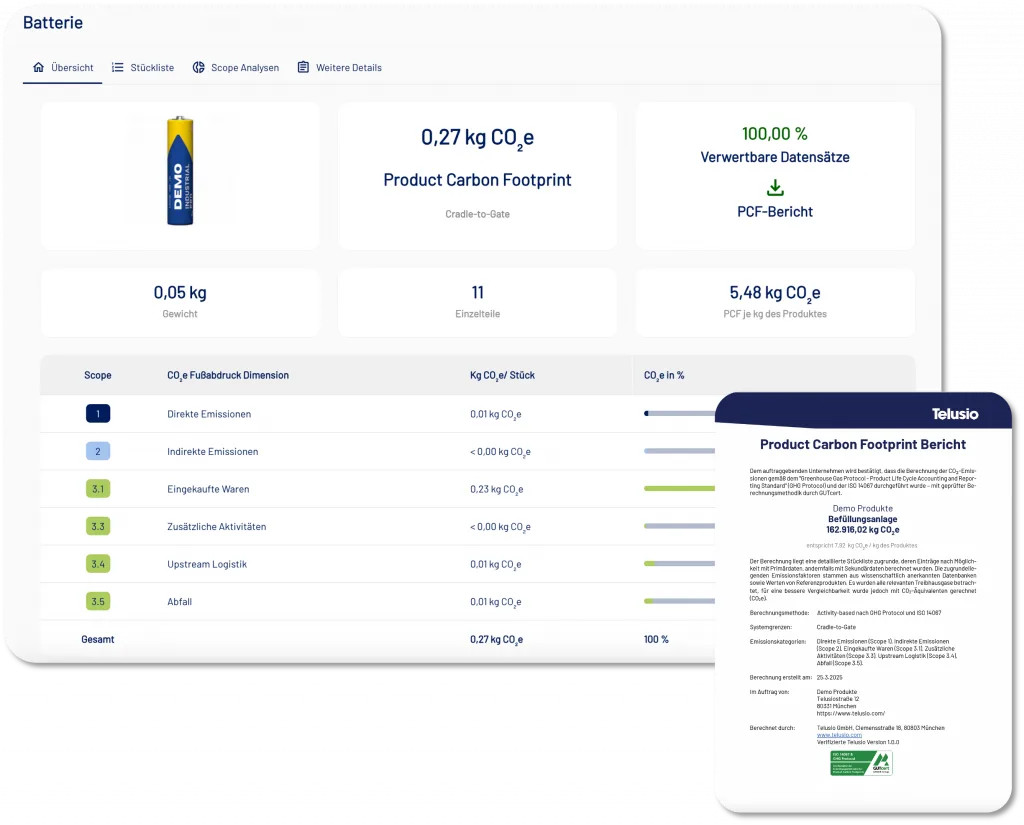
3. Plan time and resources realistically
An often underestimated aspect of PCF assessment is the time required. Coordinating different departments, preparing bills of materials, obtaining external data and aligning methodological principles take time and capacity. Clear responsibilities are often lacking, and sustainability topics are organisationally separate from day-to-day business.
Using software solutions can significantly reduce the effort for PCF calculations and make it easier to plan and estimate. In our current market study (2025) with more than 100 companies surveyed in Germany, participants stated that they expect 7.5 times more work if the PCF is calculated manually instead of with suitable software.
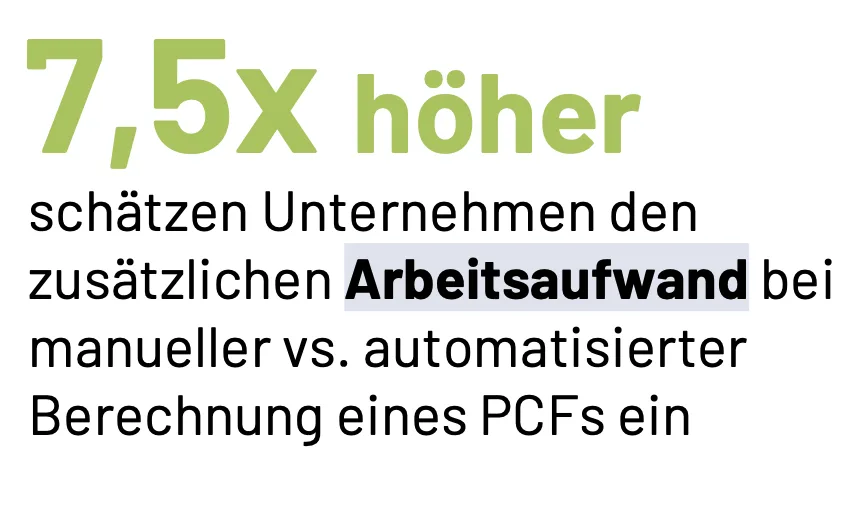
Since the PCF calculation is the central goal of the project, the entire project planning should be consistently aligned and coordinated with it – with a defined time frame, clear budgeting and clear allocation of responsibilities. Management should also be involved early on to secure resources and underline the strategic relevance. Especially the first time, it makes sense to deliberately plan buffers and set realistic milestones. It may also be worth checking whether certain process steps can be at least partially automated to reduce the effort sustainably.
4. Be clear about the product to be assessed
Especially the first time, the question often arises:
which product should be calculated – and in which version?
For complex products with many variants, customer-specific versions or modular designs, the choice of the specific configuration is crucial. It influences not only the data required but also the significance and comparability of the later PCF. Especially when calculating the PCF manually, it is essential to commit early to a specific configuration of the product to be calculated, as changing the product or calculation variant later usually involves considerable extra work or is no longer feasible.
Using PCF software solutions, on the other hand, offers much more flexibility: different variants can be considered individually per product and adjusted later if necessary – for example for new product generations or changed customer specifications – without having to set up the entire PCF process again.
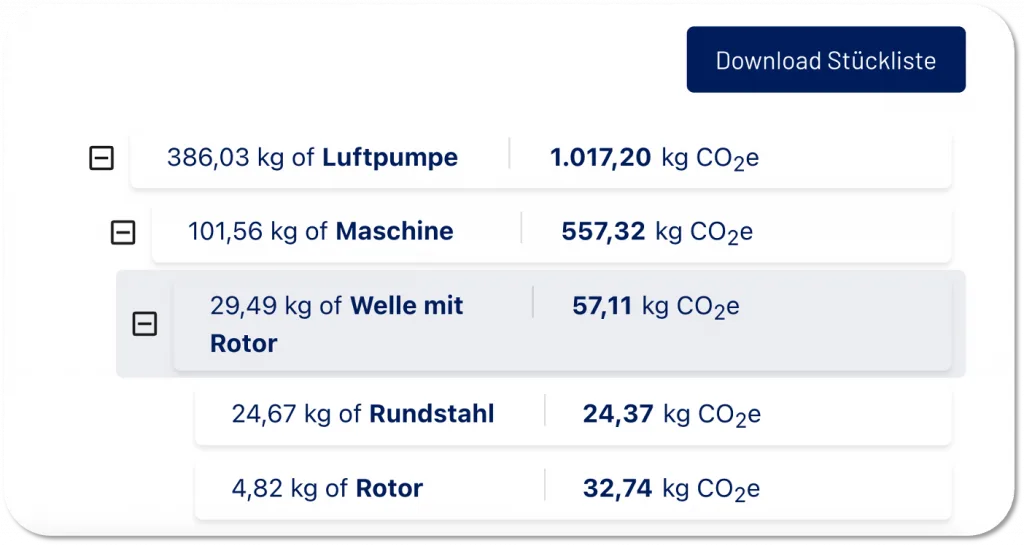
A precise definition of the product scope – including a clear distinction from optional or variant-dependent components – makes data collection considerably easier. Combined with a clean bill of materials structure and clear naming, the risk of ambiguity or duplicate work is reduced. Digital tools can help here, for example through automated variant management or the selection of relevant components within a configurable product model.
5. Document results traceably
A Product Carbon Footprint is only reliable if the calculation steps and assumptions made have been documented transparently and systematically. In addition to the emission values themselves, all underlying assumptions, data sources used, calculation methods and system boundaries should be clearly recorded. Only then can results be updated, demonstrated or defended in audits later.
Especially when carrying out a PCF assessment on your own, it helps to set up a clear documentation structure from the start – with versioning, source references and methodological explanations. This transparency is not only crucial for internal consistency but also a prerequisite for external reporting according to standards such as the Greenhouse Gas Protocol or ISO 14067.

Conclusion: a PCF needs structure – and a strategic approach
Calculating a Product Carbon Footprint is more than an arithmetic exercise – it is a methodologically demanding process with numerous interfaces and data sources.
Those who approach the basics in a structured way from the start – from system boundaries and master data to the choice of product – lay the foundation for a reliable result. Especially the first time, clear processes and digital support help keep the effort manageable.
This turns the PCF into a sound tool for corporate climate strategies and sustainable decisions.


Your customer is asking for a PCF?Let’s talk.
Discover the easiest way to audit-ready PCFs – AI-powered and expert-reviewed.
Book an initial call