
Blog
Insights from PCF practice
Studies, analyses and experience from projects with industrial companies.Articles are currently available in German only.
Articles are currently available in German only.
Companies are increasingly dealing with calculating the Product Carbon Footprint (PCF) of their products. Regulatory requirements such as the CSRD, CBAM and the battery passport increase the pressure – our current PCF Study 2025 shows that companies are taking action.
For the study, we surveyed 150 companies in Germany – from battery manufacturers to plant builders, with revenues between €1 million and €2 billion. Participants range from supervisory board chairs to sustainability experts from companies of every size, from small businesses with fewer than 50 employees to large corporations with more than 1,000 employees.
The trend: from PCF pilot projects to company-wide scaling
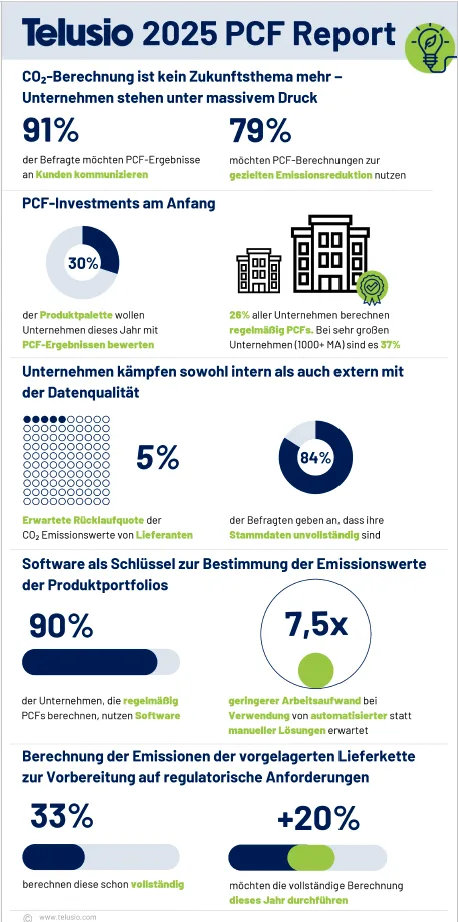
While almost two thirds of companies have already carried out initial PCF calculations, the companies surveyed want to go one step further this year and cover 30% of their product portfolio with PCF values in 2025. Calculating the Product Carbon Footprint is thus evolving from a one-off measure into a strategic basis for sustainable decisions.
Companies that calculate PCFs regularly are increasingly relying on automation – saving up to 7.5 times more time than with manual calculations. Clear success factors are early master data preparation, close collaboration with suppliers and the targeted use of software solutions.
Supply chain emissions move into focus
In addition to product assessment, recording the entire supply chain is moving centre stage. A third of companies have already calculated the complete emissions of their suppliers, and a further 20% plan to do so in 2025.
Missing supplier data and incomplete master data remain the biggest challenges. Nevertheless, companies are pushing implementation forward in a targeted way.
Battery passport: pioneer for digital product passports
The battery passport shows the challenges involved in carbon accounting in supply chains. Many companies are already obliged to record the relevant data – but uncertainties remain. While large companies often have their own standards, SMEs often rely on external consultants. Those who gain experience with digital product passports early secure long-term advantages.
Download the PCF Study 2025 now – including a one-pager for a quick overview!
In addition to the detailed study slides, a compact one-pager is available – ideal for sharing internally with teams and management.
 Download the study results
Please send the download link to the following e-mail address:




Your customer is asking for a PCF?Let’s talk.
Discover the easiest way to audit-ready PCFs – AI-powered and expert-reviewed.
Book an initial call